For more than two years me and some of my friends are pushing for bank loans for the needy and meritorious students, of Orissa, in professional colleges.
The public sector banks, including SBI, have on policy adopted that up to 5 lakhs, they will give loan, without any security, if a student is a first class student. B
In practice however this has not happened. Though as a publicity stunt they have
competed with each other to help students such as Dipak Das.
Two reasons that we have found from personal investigation, are:
1. Graft, i.e. by only making kids and their families run, a price can be extracted.
2. Past history:
a. It has been found that some students after taking loan for study default in paying back the loans. This has been highlighted by the 1st category officers above to justify their harassment. Additionally SBI and other public sector banks have in case of defaulters ended up in holding responsible personally SBI managers of the branches for these loans, per commercial practice. Faced with the situation other bank managers have started avoiding granting such study loans, altogether or have insisted on security.
The real poor have thus only two ways left for them:
i. To find a relative to come in and provide the security.
ii. Just give up the hope of higher studies after trying for a few months or bribe their way out of the jam. And many don’t have even money to pay the bribe. They pay bribe from the loaned money and are so bitter, that they are very reluctant to pay back the money to the bank
Thus the ‘unsecured’ loan for meritorious and poor students have fallen by the way side. This has devastated impoverished states like Orissa, where first kid in the college in many economically backward families and in backward areas are reaching colleges
Some of us have seriously looked at the situation. One solution is to create a corpus fund of say couple of lakhs and provide the security to the Banks to provide loans. This way a much smaller amount of money can provide bank security to much larger amount of Bank loans.
Example: Let us say college C’s alumni raise a fund of 10 lakhs. If we give this money away as scholarship to 40 people (@25 thousand per year) it will get finished in a year. However if we give it as loan to same 40 people, all we have to do is to continue for 4 more years and then it will repeat itself without any external money.
So 40 lakhs will perpetuate itself to provide for 40 students every year.
Still better would be to use these 10 lakhs and keep it in a bank as a security deposit. Or create a corpus fund from which will be used as a security. In this case 10 lakhs can be used as security money for 40 students each year and next year’s money can be used for another 40 and similarly so 160 students can be supported and the cycle repeated.
The other alternative will be to insure the loans and pay insurance from the earnings of the 10 lakhs.
I would like to have banks look at it and see what the holes in this argument are.
Advantages of alternative method:
1. Security money for say 160 students who take loan from the banks, without paying out the money.
2. Use the money’s yearly interest to pay the insurance premium for the student loans, thus leveraging the money to get loans for much higher number of students than the 40 otherwise possible.
Basic philosophy in promoting bank loan are:
• Students spend their time in studying and not waste their time to run to the banks.
• If they are admitted to, say NIT, and evaluated to have financial need, as per a standard, they are ensured loan.
• They pay back when they get job. If they don’t market interest are charged to them rather than subsidized student loan rates. These days good students, who go to good Engineering colleges, are getting jobs even before they leave college.
• They pay back the bank loan and insurance money as soon as they are capable, so the fund grows.
How too prevent default and reduce risks of student loans to SBI, some ideas:
1. We create SHG of the students from 1st year onwards, who are expected to persuade the passed out student to return the money – so they can get loan (using the general principles of SHG).
2. Since the senior most and next junior class students are still in the college at the same time as those who graduated out, and they still need money, they will have enough clout to push for repayment, by their seniors.
3. The SBI or other banks, which have a collection department, only need to get the address of the graduated students to ensure recovery. This can be easily ensured by the above non-traditional channels to reduce the risks involved.
4. Additionally, the students come one year later for the degree and convocation function. If college authorities are in the loop thus they can also help.
5. If we start it at an eminent college like NITR and test modus operendi we can fine tune and move them to other colleges, Most importantly, the seniors who help the juniors to network for jobs, will help pressurize the less than one in 100, who default.
6. Civil society members and eminent persons like the FFE facilitators can ensure that they will provide the addresses of the students, when they graduate.
What Banks can do to improve their public images and eradicate genuine grievances:
They can take few very simple steps:
1. Every year publish a budget their target of lone they want to sanction, on their web site.
a. With security
b. Without security.
2. Between September and March publish every month on web site, the progress:
a. Number of Applicants
i. For secured loans
ii. For unsecured loans
b. No of loans sanctioned by each branch divided in to two categories:
i. Unsecured
ii. Secured
iii. No of pending applications
c. Provide at each bank branch a list of names of loans status in each category in item b, which can be seen by public, similar to documents for public view per provisions of Right to Information Act.
3. Declare a few eminent institutes of the state as institutes of eminence, (which they really are) and qualify anyone admitted there for bank loans, such as:
a. NIT, Rourkela,
b. UCE, Burla,
c. IGIT, Samal,
d. CET, Bhubaneswar,
e. SCBMCollege, Cuttack,
f. VSSMCollege, Burla and
g. MKCGMCollege, Berhampore,
h. Ravenshaw College, Cuttack,
i. BJB College, BBSR,
Tuesday, February 06, 2007
Monday, February 05, 2007
My letter to PM on IITs - Feb 4 2007
To: Dr. Manmohan Singh,
Prime Minister of India
Tel: 91-11-2301-2312 , 2301-8939
E-mail: pmosb@pmo.nic.in
http://pmindia.nic.in/write.htm
cc: Mrs. Sonia Gandhi,
President of Indian National Congress and UPA
10, Janpath, New Delhi 110011 India
PH: 91-11-23014161 , 23014481
E-Mail: soniagandhi@sansad.nic.in, aicc@congress.org.in
cc:Mr. Naveen Patnaik, Chief Minister, Orissa, BBSR,
cmo@ori.nic.in
BCC: Members of Parliament of Orissa
Dear Prime Minister:
To all of us, the people of Orissa, the following news is a bolt from the blue. We are asking ourselves – What wrong, have we done, to deserve this, stepmotherly actions from Goverment of India(GOI), time and again?
Because unlike others:
1. We, Orissans did not in our protests (http://iiser.blogspot.com/ ) last year, use any of the disruptive mechanisms like:
* Rasta Roko,
* Rail Roko
* Bundhs etc
2. Instead we used peaceful and modern methods such as:
a. letter writing,
b. candle light vigils,
c. writing in news media,
d. talked to our representatives (MPs) and convinced them to talk to YOU and the Indian parliament.
But instead of being rewarded for our civil behavior and methods, it seems now we are being punished. In this time of strife and terrorism, in many parts of India and world, is this the message you SIR, want to send to your people?
The clear message seems to be: BE VIOLENT AND WE WILL THEN NEGOTIATE WITH YOU? OTHEREWISE WE DON'T CARE OR GIVE A DAMN, AS TO WHAT YOU SAY.
BECAUSE when those who get violent, get what they want, the civil society concludes as follows:
* Protest violently and you get an IIT or similar institution as reward (example: IIT in Assam, Central Institute of Technology, Kokrajhar, Assam as a deal with the Bodos, Sant Longowal Inst. in Punjab, etc.)
* and if you protest peacefully, GOI will punish you, i.e., even take away an announced for IIT or two.
* Hold us to ransom, YOU HAVE YOUR WAY.
* Do non-violent protest and WE GIVE YOU A DAMN.
We believe in peaceful, non-violent and non-disruptive protests and thus we are again writing to you.
We sincerely hope that you will annul the steps amounting to punishment of taking away an IIT from Orissa. Additionally, you will allocate an IIT for Orissa in the 11th plan, as was announced by your (the union) minister of state for HRD Mr. Fatmi on August 28th at Patna.
We also sincerely believe that the 2nd campus of IIT, Kharagpur in Orissa will not only be restored but will be taken full throttle forward and fructified into a full sister IIT of IIT, Kharagpur.
We are shocked to hear recently in Decmeber the following:
19th December 2006: (Various News reports)
The government will set up the eighth Indian Institute of Technology (IIT) in Andhra Pradesh, Chief Minister Y.S. Rajasekhara Reddy announced in the state assembly Tuesday.
20th December 2006 (News reports)
http://timesofindia.indiatimes.com/NEWS/India/IITs_to_come_up_in_Bihar_Andhra_and_Rajasthan/articleshow/870671.cms
With the Union human resource development ministry approval, the path has been cleared for the setting up of three more Indian Institutes of Technology (IITs) — in Rajasthan, Bihar and Andhra Pradesh. At present there are seven IITs in the country — in New Delhi, Mumbai, Kharagpur, Kanpur, Roorkee, Chennai and Guwahati.
Because earlier we had the following news:
11th Plan: News reports say they will have establishment of three
new IITs http://economictimes.indiatimes.com/articleshow/459579.cms
Each new IITs: At a cost of Rs 4000 crores over six years.
http://economictimes.indiatimes.com/articleshow/459579.cms
28th August 2006:
http://timesofindia.indiatimes.com/articleshow/1933613.cms
"... The announcements were made by Union minister of state for HRD MAA Fatmi at the inaugural ceremony of a new experiment of the National Institute of Open Schooling (NIOS) called "On Demand Examination" here on Monday.
Fatmi said, "The proposal for one IIT for Bihar and two for Orissa and one Western Indian state besides one IIIT to Bihar will be
included in 11th Five Year Plan". ...
Additionally, during a visit to BBSR the Director of IIT, Kharagpur, had, (obviously at the GOI's concurrence), announced expanding the BBSR extension center into a full fledged branch of IIT, Kharagpur. This branch in due course was envisioned to emerge as a full IIT.
Dear Prime Minister, you can well understand our anguish, when after promising 2 IITs you give us to NONE?? This is unconscionable and unacceptable.
We urge you to reconsider your decision and undo the wrong done to Orissa and it's people.
Why SIR, is YOUR Government rubbing the Orissa's civil society's patience and sense of dignity, time and again?
You know how a sanctioned IISER was relocated out of Orissa last year to KOLKATA. The resultant public resentment/hue and cry, was taken cognizance of by YOUR Government. Consequently, the NISER foundation stone was laid by YOU, SIR during rain ruined visit of YOURS, in August, 2006. We were very pleased indeed.
But now it is turning out a palliative. The NISER, a 700 crore institution, is on it's way – but the highway rubbers of the HRD ministry have again undermined Orissa, and robbed it of two sanctioned IITs, worth in the vicinity of 8000 crores. Thus unexpectedly and shockingly now they have decided to derail one (IIT, KGP's BBSR Branch) and relocate the other, to Andhra Pradesh.
Don't you think these kinds of acts of central Government, hinder the forces of National Integration?
We do not want to over again harp on to the details of the HRD Ministry's mal-distribution of resources across India, which you as the past Deputy Chair of the planning commission, and present Chair, are well aware. This has lead to unequal development and massive discontent, time and again and year after year.
To give just one example: 2006-07 budget: MHRD is scheduled to spend Rs 4.07 on HRD-NH (HRD ministry funded higher education institutions plus institutions of national importance) per person in Orissa, where as it will spend Rs 183.08 in Delhi. The figures (published by GOI) make my point, so I don't have to.
Thus we urge you Sir not to loose sight of this gross indiscretion, of robbing the poor to pamper the rich policy of GOI's HRD ministry. We appeal to you to take corrective actions and do what is RIGHT. If you do this will reward and encourage, civil actions and behavior by the civil society of Orissa and else where.
Best wishes,
Sandip
Prime Minister of India
Tel: 91-11-2301-2312 , 2301-8939
E-mail: pmosb@pmo.nic.in
http://pmindia.nic.in/write.htm
cc: Mrs. Sonia Gandhi,
President of Indian National Congress and UPA
10, Janpath, New Delhi 110011 India
PH: 91-11-23014161 , 23014481
E-Mail: soniagandhi@sansad.nic.in, aicc@congress.org.in
cc:Mr. Naveen Patnaik, Chief Minister, Orissa, BBSR,
cmo@ori.nic.in
BCC: Members of Parliament of Orissa
Dear Prime Minister:
To all of us, the people of Orissa, the following news is a bolt from the blue. We are asking ourselves – What wrong, have we done, to deserve this, stepmotherly actions from Goverment of India(GOI), time and again?
Because unlike others:
1. We, Orissans did not in our protests (http://iiser.blogspot.com/ ) last year, use any of the disruptive mechanisms like:
* Rasta Roko,
* Rail Roko
* Bundhs etc
2. Instead we used peaceful and modern methods such as:
a. letter writing,
b. candle light vigils,
c. writing in news media,
d. talked to our representatives (MPs) and convinced them to talk to YOU and the Indian parliament.
But instead of being rewarded for our civil behavior and methods, it seems now we are being punished. In this time of strife and terrorism, in many parts of India and world, is this the message you SIR, want to send to your people?
The clear message seems to be: BE VIOLENT AND WE WILL THEN NEGOTIATE WITH YOU? OTHEREWISE WE DON'T CARE OR GIVE A DAMN, AS TO WHAT YOU SAY.
BECAUSE when those who get violent, get what they want, the civil society concludes as follows:
* Protest violently and you get an IIT or similar institution as reward (example: IIT in Assam, Central Institute of Technology, Kokrajhar, Assam as a deal with the Bodos, Sant Longowal Inst. in Punjab, etc.)
* and if you protest peacefully, GOI will punish you, i.e., even take away an announced for IIT or two.
* Hold us to ransom, YOU HAVE YOUR WAY.
* Do non-violent protest and WE GIVE YOU A DAMN.
We believe in peaceful, non-violent and non-disruptive protests and thus we are again writing to you.
We sincerely hope that you will annul the steps amounting to punishment of taking away an IIT from Orissa. Additionally, you will allocate an IIT for Orissa in the 11th plan, as was announced by your (the union) minister of state for HRD Mr. Fatmi on August 28th at Patna.
We also sincerely believe that the 2nd campus of IIT, Kharagpur in Orissa will not only be restored but will be taken full throttle forward and fructified into a full sister IIT of IIT, Kharagpur.
We are shocked to hear recently in Decmeber the following:
19th December 2006: (Various News reports)
The government will set up the eighth Indian Institute of Technology (IIT) in Andhra Pradesh, Chief Minister Y.S. Rajasekhara Reddy announced in the state assembly Tuesday.
20th December 2006 (News reports)
http://timesofindia.indiatimes.com/NEWS/India/IITs_to_come_up_in_Bihar_Andhra_and_Rajasthan/articleshow/870671.cms
With the Union human resource development ministry approval, the path has been cleared for the setting up of three more Indian Institutes of Technology (IITs) — in Rajasthan, Bihar and Andhra Pradesh. At present there are seven IITs in the country — in New Delhi, Mumbai, Kharagpur, Kanpur, Roorkee, Chennai and Guwahati.
Because earlier we had the following news:
11th Plan: News reports say they will have establishment of three
new IITs http://economictimes.indiatimes.com/articleshow/459579.cms
Each new IITs: At a cost of Rs 4000 crores over six years.
http://economictimes.indiatimes.com/articleshow/459579.cms
28th August 2006:
http://timesofindia.indiatimes.com/articleshow/1933613.cms
"... The announcements were made by Union minister of state for HRD MAA Fatmi at the inaugural ceremony of a new experiment of the National Institute of Open Schooling (NIOS) called "On Demand Examination" here on Monday.
Fatmi said, "The proposal for one IIT for Bihar and two for Orissa and one Western Indian state besides one IIIT to Bihar will be
included in 11th Five Year Plan". ...
Additionally, during a visit to BBSR the Director of IIT, Kharagpur, had, (obviously at the GOI's concurrence), announced expanding the BBSR extension center into a full fledged branch of IIT, Kharagpur. This branch in due course was envisioned to emerge as a full IIT.
Dear Prime Minister, you can well understand our anguish, when after promising 2 IITs you give us to NONE?? This is unconscionable and unacceptable.
We urge you to reconsider your decision and undo the wrong done to Orissa and it's people.
Why SIR, is YOUR Government rubbing the Orissa's civil society's patience and sense of dignity, time and again?
You know how a sanctioned IISER was relocated out of Orissa last year to KOLKATA. The resultant public resentment/hue and cry, was taken cognizance of by YOUR Government. Consequently, the NISER foundation stone was laid by YOU, SIR during rain ruined visit of YOURS, in August, 2006. We were very pleased indeed.
But now it is turning out a palliative. The NISER, a 700 crore institution, is on it's way – but the highway rubbers of the HRD ministry have again undermined Orissa, and robbed it of two sanctioned IITs, worth in the vicinity of 8000 crores. Thus unexpectedly and shockingly now they have decided to derail one (IIT, KGP's BBSR Branch) and relocate the other, to Andhra Pradesh.
Don't you think these kinds of acts of central Government, hinder the forces of National Integration?
We do not want to over again harp on to the details of the HRD Ministry's mal-distribution of resources across India, which you as the past Deputy Chair of the planning commission, and present Chair, are well aware. This has lead to unequal development and massive discontent, time and again and year after year.
To give just one example: 2006-07 budget: MHRD is scheduled to spend Rs 4.07 on HRD-NH (HRD ministry funded higher education institutions plus institutions of national importance) per person in Orissa, where as it will spend Rs 183.08 in Delhi. The figures (published by GOI) make my point, so I don't have to.
Thus we urge you Sir not to loose sight of this gross indiscretion, of robbing the poor to pamper the rich policy of GOI's HRD ministry. We appeal to you to take corrective actions and do what is RIGHT. If you do this will reward and encourage, civil actions and behavior by the civil society of Orissa and else where.
Best wishes,
Sandip
Tuesday, January 02, 2007
A forwarded New Year Card - Very innovative
As I jumped off the building's 11th floor ... ... ... ..
10th floor

9th floor

7th floor

6th floor

4th floor

3rd floor

2nd floor

Now the ground zero


Ya. Life in all its sorrows and happiness, is still beautiful and precious ... .
10th floor
9th floor
7th floor
6th floor
4th floor
3rd floor
2nd floor
Now the ground zero
Ya. Life in all its sorrows and happiness, is still beautiful and precious ... .
Do make the best of it ... ... ... .Only Cheers ... .n ... .smiles are counted.
Text of my 2007 New Year card
| |

Tuesday, December 12, 2006
Why can't we sell at the Iron ore at world market price? - Sandip K. Dasverma
Re: Selling iron at Rs. 27 / Tonne or about $0.57 cents/ Tonne** when real prices in the world market are $84.4 plus. And going up.
An article is in Wall Street Journal of December 6, 2006. I had said earlier in my last June's blog ( http://mathtalentsearch.blogspot.com/2006/06/revisiting-orissa-development-plans.html ) that the steel Industrialists are not in Orissa for their love of Orissa but for making super profits and to tie up remaining Iron ore deposits through MOUs(Memorandum Of Understanding). And that instead of collaborating with other states in India (Chhatisgarh & Jharkhand) like the OPEC (Organization of Petroleum Exporting Countries) GOO is foolishly competing with them(and they with each other) and bringing down the price of the ores and diluting the terms and position of strength they are in, I speculated. Now cat is out of the bag. It is clear that POSCO is moving to Orissa because Government of Brazil wanted them to pay the market price for iron ore. Obviously the 30% swap is a sham. They can’t export steel because the official GOO policy, which allows export of steel, only after conversion. So this is a brilliant maneuver to hood wink the established GOO policy with inside help. Once it is exported from their private port who will keep the count of quantity? The fox will be in charge of the hen house, is not it? Expecting the inspector level GOO officers to do it will be like expecting and asking low paid police constables to keep law and order in the City.
Our bureaucrats are so ill informed or compromised that not only are they selling iron at Rs. 26 / Tonne or about $0.57 cents/ Tonne** when real prices in the world market are $84.40, and going up.
I have so far oly seen one initiative by Dr. Jatish Mohanty, the conscientious retired bureaucrat and his team petitioning the President of India. So the GOO can share 50% of the profits due this difference in price of Ore, which is fixed by Government of India. But no other initiative. The Government of Orissa, under Naveen babu has remained as secretive as ever.
I had also argued about the externals (costs of restoring the environment).
I had also noted the deafening silence of our academia and journalists.
And since then only advancement or development has been further give away. To add to the scandalous low prices of Ores, POSCO has managed to get SEZ qualification to their factories, so they don't pay sales tax for 1st 5 years and half sales tax for another 5 years. This is like adding insult to injury.
It is like Dr. Chitta Baral says - giving away family silver.
Why can't we make them pay the market price?? Why can’t we make them pay for the externals? Who is protecting POSCO and the give away and why is Government of India, bent on giving away for cheap ores when price in the world market is increasing in leaps and bounds? I can only speculate but it is the journalists who can answer. The opposition in the state assembly can put on question hour or activists can ask through RTI. But for some reason everyone is silent except small peasants, whose land is being acquired on behalf of the MNCs and corporate houses, by the Government of Orissa. The rest are all quiet.
Again what about our journalists and academia? What are they doing?
No wonder we are poor and this way we will remain poor, unless the give aways are replaced by enlightened self-interest, to ask for fair market prices for commodities we sell.
Yes, we can and will sell but to the highest bidder.
Do I make sense to any one??
The article for those who can't access WSJ:
Publicly, steelmakers and iron-ore producers are clashing, with some steel companies still saying the price of iron ore has reached an apex and iron-ore companies suggesting it hasn't. "The iron-ore market is tight," said Lakshmi Mittal, chief executive of Mittal Steel Co., the world's largest steel company by output and largest single iron-ore purchaser. "I do not expect an increase, but I do not see the iron-ore prices falling." Qi Xiangdong, deputy secretary general of the China Iron and Steel Association, said he expects the iron-ore price to change only by "a small margin" in 2007, either slightly up or slightly down. In some ways, a slight increase is in the best interests of Chinese steel makers because it encourages smaller or mid-level iron-ore producers to develop more reserves and helps China weed out some of its small inefficient steel makers that can't afford any price increase.
Full Text (774 words)
(c) 2005 Dow Jones & Company, Inc. Reproduced with permission of copyright owner. Further reproduction or distribution is prohibited without permission.
As talks begin between the world's major steel makers and iron-ore producers to set prices for next year, consensus is building that prices will rise between 5% and 10% and that the near-20% increase of this year won't be repeated.
Moreover, Chinese steel makers, who failed in their attempt to resist iron-ore producers' demands this year, are intent on leading the talks and setting an industry pattern. Brazil's Cia. Vale do Rio Doce, the world's largest iron-ore miner, and Shanghai Baosteel Group Corp., one of the largest steel makers in China, have been in early talks about the contracts, according to people familiar with the matter.
Iron ore is a crucial ingredient for making steel. Higher iron-ore costs could pressure steel makers' financial results or lead to higher steel prices, and could raise the cost of making everything from washing machines to cars.
Unlike previous talks, when steel makers were scrambling for supplies, the talks this year are set against a different industry backdrop. Demand for iron ore remains strong and supply tight, but not as tight as last year. Talks are also expected to proceed more quickly this year than last year when China's initial refusal to agree to a 19% increase dragged on for months.
Publicly, steel makers and iron-ore producers are clashing, with some steel companies still saying the price of iron ore has reached an apex and iron-ore companies suggesting it hasn't. "The iron-ore market is tight," said Lakshmi Mittal, chief executive of Mittal Steel Co., the world's largest steel company by output and largest single iron-ore purchaser. "I do not expect an increase, but I do not see the iron-ore prices falling." Qi Xiangdong, deputy secretary general of the China Iron and Steel Association, said he expects the iron-ore price to change only by "a small margin" in 2007, either slightly up or slightly down. In some ways, a slight increase is in the best interests of Chinese steel makers because it encourages smaller or mid-level iron-ore producers to develop more reserves and helps China weed out some of its small inefficient steel makers that can't afford any price increase.
The world's three largest iron-ore producers -- CVRD, Rio Tinto PLC and BHP Billiton Ltd. -- aren't likely to give up their pricing power easily in coming months. Roger Agnelli, president of CVRD, has hinted iron-ore prices haven't topped out yet because the increase hasn't matched the surge in price for copper, another mined mineral with rising demand. Rio Tinto Chief Executive Leigh Clifford, in a presentation to investors in October, said Chinese import demand has been growing by 50 million metric tons or more a year and that iron- ore producers, despite "record levels" of investment in new iron-ore mines, are struggling to increase iron-ore production fast enough to keep up with the commodity boom.
"The industry has, in general, underestimated the enduring strength of demand," Mr. Clifford said. Such market tightness, his comments suggest, could justify higher contract prices. Some observers point out that other big costs for steel makers such as for shipping and coal are more under control, meaning steel companies might be ready to accept a modest increase in the price of iron ore.
"The [iron-ore] producers are eager to get another price increase, and I see few ways to prevent them," said Daniel Altman, a steel analyst for emerging markets at Bear Stearns in New York. "It is not a question of if; it is how much."
The price of iron ore rose 19% in 2004, 71.5% in 2005 and 19% this year to the current price of about $44 per metric ton of iron-ore fines and $76 per metric ton of iron-ore pellets. Observers differ on their perspectives of pricing but tend to agree that price increases by iron-ore makers might be slowing and predict an increase of between 5% and 10% next year with prices flat or declining in the years that follow. Some, however, predict iron-ore companies will have the upper hand and continue increasing prices until 2009.
China has good reason to lead the talks. China produces and consumes about one-third of the more than one billion tons of steel produced globally each year, but it doesn't have plentiful cheap, high-quality iron-ore reserves. It plans to import about 320 million metric tons of iron ore this year and is increasing its internal iron-ore production as much as possible to minimize dependence on iron ore from Australia, Brazil and India.
To hedge against the increasing iron-ore prices, several steel companies such as Luxembourg-based Mittal and Pittsburgh-based U.S. Steel Corp. continue buying and developing their own mining assets.
http://infosources.blogspot.com/2006/12/steelmakers-want-to-restrain-iron-ore.html
An article is in Wall Street Journal of December 6, 2006. I had said earlier in my last June's blog ( http://mathtalentsearch.blogspot.com/2006/06/revisiting-orissa-development-plans.html ) that the steel Industrialists are not in Orissa for their love of Orissa but for making super profits and to tie up remaining Iron ore deposits through MOUs(Memorandum Of Understanding). And that instead of collaborating with other states in India (Chhatisgarh & Jharkhand) like the OPEC (Organization of Petroleum Exporting Countries) GOO is foolishly competing with them(and they with each other) and bringing down the price of the ores and diluting the terms and position of strength they are in, I speculated. Now cat is out of the bag. It is clear that POSCO is moving to Orissa because Government of Brazil wanted them to pay the market price for iron ore. Obviously the 30% swap is a sham. They can’t export steel because the official GOO policy, which allows export of steel, only after conversion. So this is a brilliant maneuver to hood wink the established GOO policy with inside help. Once it is exported from their private port who will keep the count of quantity? The fox will be in charge of the hen house, is not it? Expecting the inspector level GOO officers to do it will be like expecting and asking low paid police constables to keep law and order in the City.
Our bureaucrats are so ill informed or compromised that not only are they selling iron at Rs. 26 / Tonne or about $0.57 cents/ Tonne** when real prices in the world market are $84.40, and going up.
I have so far oly seen one initiative by Dr. Jatish Mohanty, the conscientious retired bureaucrat and his team petitioning the President of India. So the GOO can share 50% of the profits due this difference in price of Ore, which is fixed by Government of India. But no other initiative. The Government of Orissa, under Naveen babu has remained as secretive as ever.
I had also argued about the externals (costs of restoring the environment).
I had also noted the deafening silence of our academia and journalists.
And since then only advancement or development has been further give away. To add to the scandalous low prices of Ores, POSCO has managed to get SEZ qualification to their factories, so they don't pay sales tax for 1st 5 years and half sales tax for another 5 years. This is like adding insult to injury.
It is like Dr. Chitta Baral says - giving away family silver.
Why can't we make them pay the market price?? Why can’t we make them pay for the externals? Who is protecting POSCO and the give away and why is Government of India, bent on giving away for cheap ores when price in the world market is increasing in leaps and bounds? I can only speculate but it is the journalists who can answer. The opposition in the state assembly can put on question hour or activists can ask through RTI. But for some reason everyone is silent except small peasants, whose land is being acquired on behalf of the MNCs and corporate houses, by the Government of Orissa. The rest are all quiet.
Again what about our journalists and academia? What are they doing?
No wonder we are poor and this way we will remain poor, unless the give aways are replaced by enlightened self-interest, to ask for fair market prices for commodities we sell.
Yes, we can and will sell but to the highest bidder.
Do I make sense to any one??
The article for those who can't access WSJ:
Publicly, steelmakers and iron-ore producers are clashing, with some steel companies still saying the price of iron ore has reached an apex and iron-ore companies suggesting it hasn't. "The iron-ore market is tight," said Lakshmi Mittal, chief executive of Mittal Steel Co., the world's largest steel company by output and largest single iron-ore purchaser. "I do not expect an increase, but I do not see the iron-ore prices falling." Qi Xiangdong, deputy secretary general of the China Iron and Steel Association, said he expects the iron-ore price to change only by "a small margin" in 2007, either slightly up or slightly down. In some ways, a slight increase is in the best interests of Chinese steel makers because it encourages smaller or mid-level iron-ore producers to develop more reserves and helps China weed out some of its small inefficient steel makers that can't afford any price increase.
Full Text (774 words)
(c) 2005 Dow Jones & Company, Inc. Reproduced with permission of copyright owner. Further reproduction or distribution is prohibited without permission.
As talks begin between the world's major steel makers and iron-ore producers to set prices for next year, consensus is building that prices will rise between 5% and 10% and that the near-20% increase of this year won't be repeated.
Moreover, Chinese steel makers, who failed in their attempt to resist iron-ore producers' demands this year, are intent on leading the talks and setting an industry pattern. Brazil's Cia. Vale do Rio Doce, the world's largest iron-ore miner, and Shanghai Baosteel Group Corp., one of the largest steel makers in China, have been in early talks about the contracts, according to people familiar with the matter.
Iron ore is a crucial ingredient for making steel. Higher iron-ore costs could pressure steel makers' financial results or lead to higher steel prices, and could raise the cost of making everything from washing machines to cars.
Unlike previous talks, when steel makers were scrambling for supplies, the talks this year are set against a different industry backdrop. Demand for iron ore remains strong and supply tight, but not as tight as last year. Talks are also expected to proceed more quickly this year than last year when China's initial refusal to agree to a 19% increase dragged on for months.
Publicly, steel makers and iron-ore producers are clashing, with some steel companies still saying the price of iron ore has reached an apex and iron-ore companies suggesting it hasn't. "The iron-ore market is tight," said Lakshmi Mittal, chief executive of Mittal Steel Co., the world's largest steel company by output and largest single iron-ore purchaser. "I do not expect an increase, but I do not see the iron-ore prices falling." Qi Xiangdong, deputy secretary general of the China Iron and Steel Association, said he expects the iron-ore price to change only by "a small margin" in 2007, either slightly up or slightly down. In some ways, a slight increase is in the best interests of Chinese steel makers because it encourages smaller or mid-level iron-ore producers to develop more reserves and helps China weed out some of its small inefficient steel makers that can't afford any price increase.
The world's three largest iron-ore producers -- CVRD, Rio Tinto PLC and BHP Billiton Ltd. -- aren't likely to give up their pricing power easily in coming months. Roger Agnelli, president of CVRD, has hinted iron-ore prices haven't topped out yet because the increase hasn't matched the surge in price for copper, another mined mineral with rising demand. Rio Tinto Chief Executive Leigh Clifford, in a presentation to investors in October, said Chinese import demand has been growing by 50 million metric tons or more a year and that iron- ore producers, despite "record levels" of investment in new iron-ore mines, are struggling to increase iron-ore production fast enough to keep up with the commodity boom.
"The industry has, in general, underestimated the enduring strength of demand," Mr. Clifford said. Such market tightness, his comments suggest, could justify higher contract prices. Some observers point out that other big costs for steel makers such as for shipping and coal are more under control, meaning steel companies might be ready to accept a modest increase in the price of iron ore.
"The [iron-ore] producers are eager to get another price increase, and I see few ways to prevent them," said Daniel Altman, a steel analyst for emerging markets at Bear Stearns in New York. "It is not a question of if; it is how much."
The price of iron ore rose 19% in 2004, 71.5% in 2005 and 19% this year to the current price of about $44 per metric ton of iron-ore fines and $76 per metric ton of iron-ore pellets. Observers differ on their perspectives of pricing but tend to agree that price increases by iron-ore makers might be slowing and predict an increase of between 5% and 10% next year with prices flat or declining in the years that follow. Some, however, predict iron-ore companies will have the upper hand and continue increasing prices until 2009.
China has good reason to lead the talks. China produces and consumes about one-third of the more than one billion tons of steel produced globally each year, but it doesn't have plentiful cheap, high-quality iron-ore reserves. It plans to import about 320 million metric tons of iron ore this year and is increasing its internal iron-ore production as much as possible to minimize dependence on iron ore from Australia, Brazil and India.
To hedge against the increasing iron-ore prices, several steel companies such as Luxembourg-based Mittal and Pittsburgh-based U.S. Steel Corp. continue buying and developing their own mining assets.
http://infosources.blogspot.com/2006/12/steelmakers-want-to-restrain-iron-ore.html
Monday, December 11, 2006
Singur CPM's grave yard??? Or Is there a way out of this imbroglio??
I read many informative articles on Singur land acquisition. One of them by Palash Biswas is by far the most informative. It is too long – but only because it has a lot of reference information. As shown here, one can write the additional related info into Blogs, which can then be linked to one's article, as done below.
Mr. Biswas’s article’s first part is really well written. I like the reference to Mrinal Sen, Soumitra and Sunil Ganguly et el's inactivity and silence.
I believe CPM was in the right track when they raised the compensation and included the share croppers in the compensation package, hailed as most progressive so far in India. I would have liked them to persuade TATAs to relocate to Midnapore area, to one crop lands or negotiated the land demand downwards. CPM should have followed its own long standing policy on multi-crop land. They didn’t. They lost the civil society support, when they sent police in, to evict the farmers in the old fashioned way, from their land, home and hearth.
Buddhadev Bhattacharya, the CM, lost me by his latest action. I support principled stand of Medha Patkar (of Narmada Bachao Andolan fame) and Mahasweta Devi (renowned Bengali author and activist, winner of Magsasay Award) on this. I am an Engineer by profession and grew up believing, Neheruvian slogan that "Factories are modern temples", thus I am no Luddite (machine breakers). I am pained and anguished that CPM’s best bet Buddhadev Bhattachariya, the Chief Minister, did not take a principled and different path than what, say BJP would have taken. He lost it when he evicted people by resorting to police force and has landed in this imbroglio.
Many are fishing in troubled water, thus created by CPM, by their unimaginative action. This lack of imagination and contradiction of their own long standing published policy (I understand that time is money for TATAs) has opened the door for the likes of BJP and Trinamool Congress et el and others doing petty politicking.
But using police against people is the oldest tactics of renegade states and authoritarian regimes. It has no place in democratic liberal set up. CPM has lost in a big way their credibility and will now get equated with BJP regimes. By this single action they have lost the support of the civil society and the chance for a fast expansion into the vast areas of India that they could have captured and advanced into – if their action in Singur would have been different and innovative. They might have won the battle of West Bengal’s industrialization – they lost the War for minds of civil society. The proved that they are no different when push comes to shove.
Auto Factory sans the company town?
There are some ways the lost ground can be retrieved. But why can't CPM take a middle ground? Why not TATAs be persuaded to build a plant on 100 to 150 acres, sans the company town? There will be enough land in such a case for factory and even its expansion. The days of company towns are over. There are enough developers in West Bengal and around, who will build high rises in the immediate area, as the need for housing arises after or as the factory is built. The WBG (West Bengal Government) will have to prepare a master plan which mingles both factory and surrounding rural areas, seamlessly.
And for the TATA’s, the total investment required will be less, too.
And if the economic pressure and growth is enough, people will gladly give their land and relocate or be owners of high rises, or rental property, in their own interest. I have seen in my own eyes how in Sunnyvale, California, apple orchards were replaced and became housing and apartment complexes over the years, as house prices rose in the Silicon Valley. Initially they too were reluctant to move out of their orchards.
In my opinion that will be the way to go, because it will generate more jobs and employment by building the area up, instead of creating a company town with similar restrictions of growth. And we will avoid creating new zamindaris of industrialists, after getting rid of the feudal zamindari of colonial times.
Only recently CPI general secretary AB Bardhan has criticized the land acquisition policy, saying it is not in the interest of farmers. He said the chief minister's view that industrialists should be allowed to choose where they wanted to set up their projects was wrong and anti-people. "For industries, you need land. But for that you either use fallow, uncultivable land or land where moribund industrial units are situated. And if you still need agricultural land, you acquire single-crop land and pay adequate compensation to farmers," Bardhan said.
In this context I am reminded of and know about the 4000 acres that TATAS acquired nearly 10 years back in Gopalpur on Sea, Orissa, which is lying fellow. Only recently (2006) TATAs have started an operator training school after enough public hue and cries. It almost amounts to speculator land acquisition on behalf of the rich, is not it? Mind you India’s is one of the highest density populations (851per sq mile vs. 80 per squire mile in USA) in the world. Thus we can’t afford similar generosity in the policy on land, as west.
I hope and wish TATAS will try to win back their clean corporate image by:
1. acquire only enough land for the factory & leave out the rest for housing development to happen as and when people wish.
2. Set new standards of corporate sensitivity in view of public resistance to their moving in.
3. Get WB CM out of the mess he is in.
If they take the above steps everyone will win. An arrogant stand will only bring them peril.
Mr. Biswas’s article’s first part is really well written. I like the reference to Mrinal Sen, Soumitra and Sunil Ganguly et el's inactivity and silence.
I believe CPM was in the right track when they raised the compensation and included the share croppers in the compensation package, hailed as most progressive so far in India. I would have liked them to persuade TATAs to relocate to Midnapore area, to one crop lands or negotiated the land demand downwards. CPM should have followed its own long standing policy on multi-crop land. They didn’t. They lost the civil society support, when they sent police in, to evict the farmers in the old fashioned way, from their land, home and hearth.
Buddhadev Bhattacharya, the CM, lost me by his latest action. I support principled stand of Medha Patkar (of Narmada Bachao Andolan fame) and Mahasweta Devi (renowned Bengali author and activist, winner of Magsasay Award) on this. I am an Engineer by profession and grew up believing, Neheruvian slogan that "Factories are modern temples", thus I am no Luddite (machine breakers). I am pained and anguished that CPM’s best bet Buddhadev Bhattachariya, the Chief Minister, did not take a principled and different path than what, say BJP would have taken. He lost it when he evicted people by resorting to police force and has landed in this imbroglio.
Many are fishing in troubled water, thus created by CPM, by their unimaginative action. This lack of imagination and contradiction of their own long standing published policy (I understand that time is money for TATAs) has opened the door for the likes of BJP and Trinamool Congress et el and others doing petty politicking.
But using police against people is the oldest tactics of renegade states and authoritarian regimes. It has no place in democratic liberal set up. CPM has lost in a big way their credibility and will now get equated with BJP regimes. By this single action they have lost the support of the civil society and the chance for a fast expansion into the vast areas of India that they could have captured and advanced into – if their action in Singur would have been different and innovative. They might have won the battle of West Bengal’s industrialization – they lost the War for minds of civil society. The proved that they are no different when push comes to shove.
Auto Factory sans the company town?
There are some ways the lost ground can be retrieved. But why can't CPM take a middle ground? Why not TATAs be persuaded to build a plant on 100 to 150 acres, sans the company town? There will be enough land in such a case for factory and even its expansion. The days of company towns are over. There are enough developers in West Bengal and around, who will build high rises in the immediate area, as the need for housing arises after or as the factory is built. The WBG (West Bengal Government) will have to prepare a master plan which mingles both factory and surrounding rural areas, seamlessly.
And for the TATA’s, the total investment required will be less, too.
And if the economic pressure and growth is enough, people will gladly give their land and relocate or be owners of high rises, or rental property, in their own interest. I have seen in my own eyes how in Sunnyvale, California, apple orchards were replaced and became housing and apartment complexes over the years, as house prices rose in the Silicon Valley. Initially they too were reluctant to move out of their orchards.
In my opinion that will be the way to go, because it will generate more jobs and employment by building the area up, instead of creating a company town with similar restrictions of growth. And we will avoid creating new zamindaris of industrialists, after getting rid of the feudal zamindari of colonial times.
Only recently CPI general secretary AB Bardhan has criticized the land acquisition policy, saying it is not in the interest of farmers. He said the chief minister's view that industrialists should be allowed to choose where they wanted to set up their projects was wrong and anti-people. "For industries, you need land. But for that you either use fallow, uncultivable land or land where moribund industrial units are situated. And if you still need agricultural land, you acquire single-crop land and pay adequate compensation to farmers," Bardhan said.
In this context I am reminded of and know about the 4000 acres that TATAS acquired nearly 10 years back in Gopalpur on Sea, Orissa, which is lying fellow. Only recently (2006) TATAs have started an operator training school after enough public hue and cries. It almost amounts to speculator land acquisition on behalf of the rich, is not it? Mind you India’s is one of the highest density populations (851per sq mile vs. 80 per squire mile in USA) in the world. Thus we can’t afford similar generosity in the policy on land, as west.
I hope and wish TATAS will try to win back their clean corporate image by:
1. acquire only enough land for the factory & leave out the rest for housing development to happen as and when people wish.
2. Set new standards of corporate sensitivity in view of public resistance to their moving in.
3. Get WB CM out of the mess he is in.
If they take the above steps everyone will win. An arrogant stand will only bring them peril.
Sunday, November 12, 2006
Why Me? - Arthur Ashe the legend...
Arthur Ashe, the legendary Wimbledon player was dying of AIDS which he got
due to infected blood he received during a heart surgery in 1983.
From world over, he received letters from his fans, one of which conveyed:
"Why does GOD have to select you for such a bad disease"?
To this Arthur Ashe replied: "The world over 5 crore children start playing
tennis, 50 lakh learn to play tennis, 5 lakh learn professional tennis,
50,000 come to the circuit, 5000 reach the grand slam, 50 reach Wimbledon,
4 to semi final, 2 to the finals, When I was holding a cup I never asked GOD
"Why me?".
And today in pain I should not be asking GOD "Why me?"
due to infected blood he received during a heart surgery in 1983.
From world over, he received letters from his fans, one of which conveyed:
"Why does GOD have to select you for such a bad disease"?
To this Arthur Ashe replied: "The world over 5 crore children start playing
tennis, 50 lakh learn to play tennis, 5 lakh learn professional tennis,
50,000 come to the circuit, 5000 reach the grand slam, 50 reach Wimbledon,
4 to semi final, 2 to the finals, When I was holding a cup I never asked GOD
"Why me?".
And today in pain I should not be asking GOD "Why me?"
Friday, November 03, 2006
Our Family Daity at Cuttack, Orissa, India
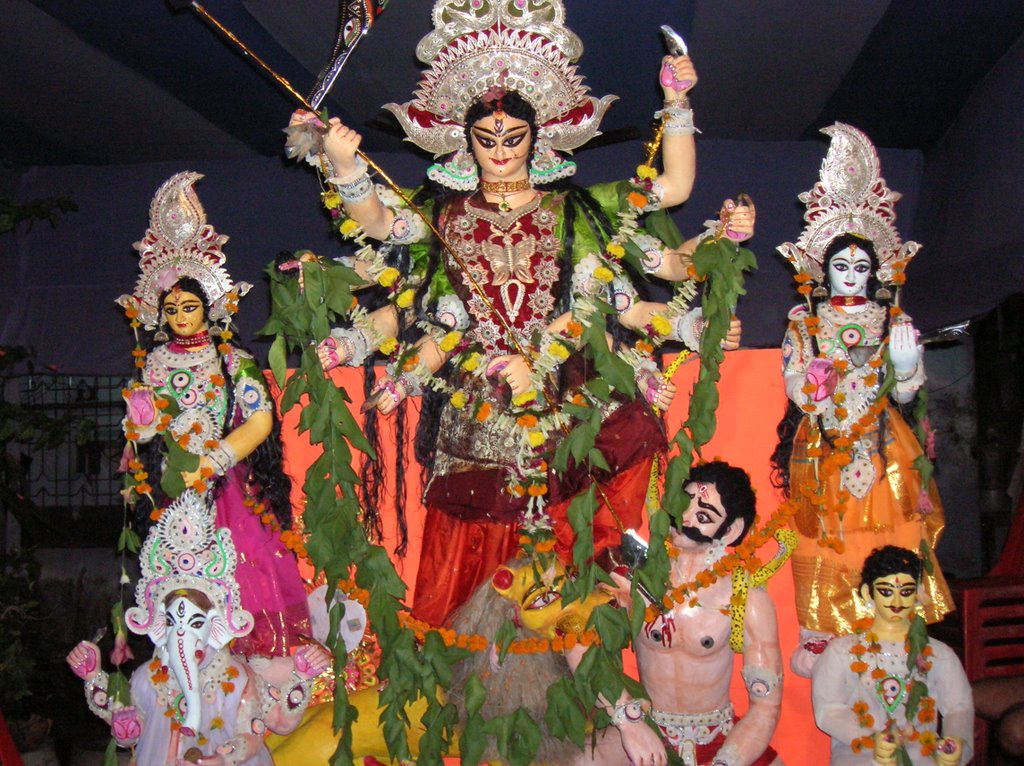
Dasabhuja Durga with Lakshi, Saraswati, Ganesh, Kartick and Mahishashur, Year 2005 which is built by my younger brother.....
Thursday, November 02, 2006
The Naxalite Menace - What is the reason?? How can it be solved??
I read the recent discussions in various forums and write up by many others on Naxalite movement in Orissa(India) and it's menace. Here are my 2 cents.
I worked in Koraput district nearly six years from 1970 to 1979 except 4 years in between. The deprivation and exploitation I saw was unacceptable and revolting. Have you read Late Gopinath Mohanty's "Paraja"? Though fictional the story is not far from truth for many people in the district. Many leaders have been killed, jailed and maimed. Yet the movement has survived for nearly 40 years now (from 1967). Obviously the ground realities are creating more revolutionaries as they are being killed, won over or withering away with age. These objective conditions must be changed. And 40 years is a long time. What GOO has done is, raised more OMP platoons and provided them with more and better weapons. Have you seen Nishant, the movie, by Shyam Benegal? Tell me if those conditions persist - how can the resistance to it go away? I am more than 25 years out of the country but when I go back I see that a few have become much richer by out right theft (high level of corruption) and the rest are probably as a percent of population going backwards. The difference between "India" and "Bharat" is on the increase. The buffer, the Gandhians are dieing one by one and the civil society consists of spineless people who say what the Govt of the day, want to hear. To day after 60 years of Independence 600 million people of what I call "Bharat" don't have Food security, health security, shelter security, education security, basic human rights security. It is all available in the law book but not actually for "Bharat" but "INDIA" can buy their way or influence, to get it. For "Bharat" there is no chance because it does not have the money to buy into it. Interestingly for whole of India - "India" is 600 million and "Bharat" is 600 million, i.e. 50/50 but for Orissa it is 75/25. I only hope and wish GOO and GOI will be wise enough to spend 75/25 on breads vs. guns rather than the other way around.In such a case the so called menace would go away. At least I think so. Some will say that GOO does not have money to spend on anything so where is the question of buying Guns vs. Bread come from?
To them I say that this will continue as long as the give away to the MNCs and the big business continues along side continued neglect of the small man and backward areas, for lack of resources. Tell me why should GOO give away iron ore rights to POSCO for less than Rs 250 / tonne, when market price of ore is Rs. 2500 / tonne? The curt answer of our intellectuals is Oh, they will go away from Orissa. Are there no Economics or Business professor in Vani Vihar to advise the GOO, as to what to do, under such circumstances? What the history says? Why Govt of Orissa can't form a cartel with Govt of Chatisgarh, Jharkhand, Maharastra and Karnataka, the only other states of India, who have Iron ore and coal? Instead they compete with each other and bring down the prices? Whose interest thus they serve?
Why can't we learn from what middle east's OPEC has done, since mid 70s when it was realised that Petroleum supply is not infinite? I still remember in 1970 a barrel of oil was $1.32. Today it is hovering around $70.00. Yet GOO seating on 91% of chromite ore is practically throwing away the money that could be used for education, Roads, and other development in the state. And the state is always running short of money, while it gives away the store. I can go on and on. It is a confluence of incompetence, lack of imagination, corruption and lack of compassion which has landed us in this unenviable situation.
Naxalite movement is a symptom of this desease. It will go away once the desease is cured and objective conditions removed.
I worked in Koraput district nearly six years from 1970 to 1979 except 4 years in between. The deprivation and exploitation I saw was unacceptable and revolting. Have you read Late Gopinath Mohanty's "Paraja"? Though fictional the story is not far from truth for many people in the district. Many leaders have been killed, jailed and maimed. Yet the movement has survived for nearly 40 years now (from 1967). Obviously the ground realities are creating more revolutionaries as they are being killed, won over or withering away with age. These objective conditions must be changed. And 40 years is a long time. What GOO has done is, raised more OMP platoons and provided them with more and better weapons. Have you seen Nishant, the movie, by Shyam Benegal? Tell me if those conditions persist - how can the resistance to it go away? I am more than 25 years out of the country but when I go back I see that a few have become much richer by out right theft (high level of corruption) and the rest are probably as a percent of population going backwards. The difference between "India" and "Bharat" is on the increase. The buffer, the Gandhians are dieing one by one and the civil society consists of spineless people who say what the Govt of the day, want to hear. To day after 60 years of Independence 600 million people of what I call "Bharat" don't have Food security, health security, shelter security, education security, basic human rights security. It is all available in the law book but not actually for "Bharat" but "INDIA" can buy their way or influence, to get it. For "Bharat" there is no chance because it does not have the money to buy into it. Interestingly for whole of India - "India" is 600 million and "Bharat" is 600 million, i.e. 50/50 but for Orissa it is 75/25. I only hope and wish GOO and GOI will be wise enough to spend 75/25 on breads vs. guns rather than the other way around.In such a case the so called menace would go away. At least I think so. Some will say that GOO does not have money to spend on anything so where is the question of buying Guns vs. Bread come from?
To them I say that this will continue as long as the give away to the MNCs and the big business continues along side continued neglect of the small man and backward areas, for lack of resources. Tell me why should GOO give away iron ore rights to POSCO for less than Rs 250 / tonne, when market price of ore is Rs. 2500 / tonne? The curt answer of our intellectuals is Oh, they will go away from Orissa. Are there no Economics or Business professor in Vani Vihar to advise the GOO, as to what to do, under such circumstances? What the history says? Why Govt of Orissa can't form a cartel with Govt of Chatisgarh, Jharkhand, Maharastra and Karnataka, the only other states of India, who have Iron ore and coal? Instead they compete with each other and bring down the prices? Whose interest thus they serve?
Why can't we learn from what middle east's OPEC has done, since mid 70s when it was realised that Petroleum supply is not infinite? I still remember in 1970 a barrel of oil was $1.32. Today it is hovering around $70.00. Yet GOO seating on 91% of chromite ore is practically throwing away the money that could be used for education, Roads, and other development in the state. And the state is always running short of money, while it gives away the store. I can go on and on. It is a confluence of incompetence, lack of imagination, corruption and lack of compassion which has landed us in this unenviable situation.
Naxalite movement is a symptom of this desease. It will go away once the desease is cured and objective conditions removed.


Thursday, October 26, 2006
RTI Application to SBI, BBSR -
Required Information
1. What are the documents needed for a statement loan from SBI?
2. What are special considerations for SCs/STs and backward area student loan?
3. Please provide the district wise amount of student loans sanctioned during the financial years 2001 to 2006 and the budgeted amount for each year. for each year.
4. Please provide the data relating to students loans during the financial year 2004-05 in the following format.
1. Name of the student
2. Institution belonging to District Name
3. Income of Guardian
4. Details of Securities
5. Date of Application
6. Date of Sanction
7. Amount of Loan
1. Please provide the total no. of loan applications during the year 2004-05 (District Wise) and rejections with grounds of rejections (Category wise).
2. Please categories the list of student loans stream wise (like arts, commerce, science, engineering etc).
3. Please provide a cooperative list of student loans sanctioned state wise in the following format for the year 2004-05.
1. Name of the State
2. Total No of Application sanctioned
3. Without Security
4. Total Amount Sanctioned
5. With Security
6. Total Provisional Amount
8. Please provide the information under budgeted and disbursal figures of 2004, 2005, 2006 required for AP and Orissa, minimum.
9. Please provide the information For Orissa For 2000, 2005
1. the total number of students granted loan with security,
2. the total number of students granted loan without security,
3. no of applications received,
4. no of applications sanctioned
5. and amount sanctioned for each and in total,
6. No of applications rejected with reason, why?
1.
Please provide the following information For Orissa for the period of 2006, district wise, and branch wise::
1. the total number of students granted loan with security,
2. the total number of students granted without security,
3. no of applications received,
4. no of applications sanctioned,
5. No of applications rejected with reason, why?
6. . And number of applications pending, now branch wise with date of application received?
1. What are the documents needed for a statement loan from SBI?
2. What are special considerations for SCs/STs and backward area student loan?
3. Please provide the district wise amount of student loans sanctioned during the financial years 2001 to 2006 and the budgeted amount for each year. for each year.
4. Please provide the data relating to students loans during the financial year 2004-05 in the following format.
1. Name of the student
2. Institution belonging to District Name
3. Income of Guardian
4. Details of Securities
5. Date of Application
6. Date of Sanction
7. Amount of Loan
1. Please provide the total no. of loan applications during the year 2004-05 (District Wise) and rejections with grounds of rejections (Category wise).
2. Please categories the list of student loans stream wise (like arts, commerce, science, engineering etc).
3. Please provide a cooperative list of student loans sanctioned state wise in the following format for the year 2004-05.
1. Name of the State
2. Total No of Application sanctioned
3. Without Security
4. Total Amount Sanctioned
5. With Security
6. Total Provisional Amount
8. Please provide the information under budgeted and disbursal figures of 2004, 2005, 2006 required for AP and Orissa, minimum.
9. Please provide the information For Orissa For 2000, 2005
1. the total number of students granted loan with security,
2. the total number of students granted loan without security,
3. no of applications received,
4. no of applications sanctioned
5. and amount sanctioned for each and in total,
6. No of applications rejected with reason, why?
1.
Please provide the following information For Orissa for the period of 2006, district wise, and branch wise::
1. the total number of students granted loan with security,
2. the total number of students granted without security,
3. no of applications received,
4. no of applications sanctioned,
5. No of applications rejected with reason, why?
6. . And number of applications pending, now branch wise with date of application received?
Thursday, October 19, 2006
Kudos to Dr. Younus from Sandip
Being sorry for the poor or having empathy for them is an old story. You had both but you took it beyond that to release their energy for their own good. Your action has saved them from double jeopardy.
1. The oppression of the usary of private lenders - an age old phenomenon - in all countries and all cultures.
2. Hard working and talented people remaining poor for want of capital, a catch 22 situation, Capital they could not get because they could not give security and/or pleade assests. And Assets they could not build before they got capital for their perfect business plans.
Your idea and you have intervened like God in their hopeless and hapless lives.
This empowerment will help most of the poor in the world in coming decades to ride out of poverty - I believe.
Thus I extend my heart felt regards and congratulations, as I enjoy the reflected glory as a co-South Asian.
Best wishes,
Sandip
1. The oppression of the usary of private lenders - an age old phenomenon - in all countries and all cultures.
2. Hard working and talented people remaining poor for want of capital, a catch 22 situation, Capital they could not get because they could not give security and/or pleade assests. And Assets they could not build before they got capital for their perfect business plans.
Your idea and you have intervened like God in their hopeless and hapless lives.
This empowerment will help most of the poor in the world in coming decades to ride out of poverty - I believe.
Thus I extend my heart felt regards and congratulations, as I enjoy the reflected glory as a co-South Asian.
Best wishes,
Sandip
Sunday, September 24, 2006
Thursday, September 21, 2006
Saturday, September 16, 2006
Thursday, September 14, 2006
FIVE LIVES OF VANDE MATARAM by Sabyasachi Bhattacahrya
Indian Express
August 24, 2006
FIVE LIVES OF VANDE MATARAM
by Sabyasachi Bhattacharya
The history of the national song has imbued it with diverse symbolism
The appropriation of cultural creations for
political purposes may be inevitable, but it
should not happen in a state of arrogant
ignorance. The low level of knowledge now on
display in the statements and actions of many
political parties in respect of the song, Vande
Mataram, is surprising. It is surprising because
the song has been part of the language of Indian
politics for over a century. At this moment we
see a rerun of an old series of actions and
reactions intended to stage an enactment of
identity assertions.
The traditional appeal of the captivating lyric,
celebrating the beauty of the motherland, remains
as strong as ever so far as the general public is
concerned. One evidence of this is its popularity
set to
music composed by A.R. Rahman. And yet
political squabbles over the song continue.
Coverage in the electronic media provides
entertainment in juxtaposing the so-called Hindu
and Muslim points of view, a mode of presentation
which allows no other reading of the song.
Actually the meanings read into the poem have
differed widely in the 130 years since it was
written. In terms of the meanings thus attributed
there are about five different phases.
In the beginning were just the words. Reportedly
one of the leading defenders of the song and of
Hindutva has said that the song was written by
Bankim Chandra Chatterjee to honour those who
sacrificed their lives for the country. To defend
the truth about the song from such defenders it
needs to be said that when Bankim first wrote it
in the early 1870s it was just a beautiful hymn
to the motherland, richly-watered,
richly-fruited, dark with the crops of
the
harvests, sweet of laughter, sweet of speech, the
giver of bliss. For several years these first two
stanzas remained unpublished. In 1881 this poem
was included by Bankim in the novel, Anandamath,
and now it was expanded to endow the motherland
with militant religious symbolism as the context
of the narrative demanded.
However, the icon of the motherland, "terrible
with the clamour of seventy million throats",
likened to "Durga holding ten weapons of war"
etc, entered the public imagination much later.
This was from the beginning of Bengal's Swadeshi
agitation in 1905. It was sung in the Congress
session in Benaras in 1905 (music composed by
Tagore), in anti-Partition processions in
Calcutta led by Tagore, in meetings addressed by
Aurobindo Ghose. The latter hailed Bankim as the
rishi of nationalism and translated the poem into
English. Many translations were made, including
one by
Subramaniya Bharathi in 1905. Likewise,
far away from Bengal, Mahatma Gandhi took note of
the song as early as 1905. What is more, Vande
Mataram became a slogan for the common man, to
the extent he participated in anti-British
agitations. Many of the militant nationalists
faced bullets or the gallows with that slogan on
their lips. Thus Vande Mataram became sanctified
as an intrinsic part of the memories of the fight
for freedom.
A third phase in the life of the song began in
the 1930s when objections began to be raised
against the song on two grounds: first, its
association with Anandamath, which depicted the
Muslims of the Nawabi era of the 1770s in Bengal
in a poor light; second, the religious imagery
and idolatry implicit in the stanzas of the poem
following the first two. (Today those innocent of
any knowledge of the song and the novel probably
mistake the part for the whole). M.A. Jinnah,
as
well as a number of Muslim legislators in the
provincial assemblies elected in 1937, became
vociferous against the recitation or singing of
Vande Mataram, a practice introduced by
provincial Congress governments. In response to
this, as well as pressure of Congress members,
Jawaharlal Nehru in October 1937 wrote to Tagore
asking for his opinion regarding the suitability
of the song as a national anthem. The judgement
Nehru received was that the first two stanzas of
Vande Mataram should be accepted; as for the
later part of the verse, Tagore thought it might
offend monotheists, but the song was inextricably
associated with the freedom movement and "the
sacrifices of the best of our youths" since 1905.
Acting upon this advice the Congress Working
Committee recommended that "wherever the Vande
Mataram is sung at national gatherings, only the
first two stanzas should be sung". Jinnah wrote
to
Nehru in March 1938 that the decision was not
to his satisfaction but the Congress stuck to it;
in any event, there was a proviso that any one
who wished not to participate was free to do so.
>From then on the song was a dividing line between
those who doubted the wisdom of this compromise
(C. Rajgopalachari) and those, led by Nehru, who
were opposed to making the song obligatory. In
1939 some provincial governments - like Bihar and
Central Provinces - issued specific instructions
to education departments clarifying that the song
was not obligatory. A fallout was that the slogan
'Vande Mataram' acquired special connotation to
those who valued the Hindu symbolism in the song
and by 1946-47 in some parts of India it became
in inter-communal conflicts the battle cry of the
Hindu community. The earliest instance of Hindu
Mahasabha support to the sanctification of the
song is perhaps the 'Vande Mataram
Day' organised
by the party in 1937.
The fifth and most recent phase in the life of
the song commenced in the Constituent Assembly on
January 24, 1950, when it was sung at the end of
its deliberations. It was resolved that while
Jana Gana Mana was identified as the national
anthem, equally with it Vande Mataram was to be
recognised. It was a motion from the chair, moved
by Rajendra Prasad himself, and unlike other
parts of the Constitution it was never debated
upon in the Constituent Assembly. But the matter
continues to be debated until today. This is not
unexpected, given the eventful history of this
song. Judging by various erroneous statements
which are now being made, it is vitally important
to bear in mind what happened in the past. That
is because the memories of the past, rightly or
wrongly, constitute our present.
The writer, a former VC of Visva Bharati
University, Santiniketan,
is the author of 'Vande
Mataram: The Biography of a Song' (Penguin)
August 24, 2006
FIVE LIVES OF VANDE MATARAM
by Sabyasachi Bhattacharya
The history of the national song has imbued it with diverse symbolism
The appropriation of cultural creations for
political purposes may be inevitable, but it
should not happen in a state of arrogant
ignorance. The low level of knowledge now on
display in the statements and actions of many
political parties in respect of the song, Vande
Mataram, is surprising. It is surprising because
the song has been part of the language of Indian
politics for over a century. At this moment we
see a rerun of an old series of actions and
reactions intended to stage an enactment of
identity assertions.
The traditional appeal of the captivating lyric,
celebrating the beauty of the motherland, remains
as strong as ever so far as the general public is
concerned. One evidence of this is its popularity
set to
music composed by A.R. Rahman. And yet
political squabbles over the song continue.
Coverage in the electronic media provides
entertainment in juxtaposing the so-called Hindu
and Muslim points of view, a mode of presentation
which allows no other reading of the song.
Actually the meanings read into the poem have
differed widely in the 130 years since it was
written. In terms of the meanings thus attributed
there are about five different phases.
In the beginning were just the words. Reportedly
one of the leading defenders of the song and of
Hindutva has said that the song was written by
Bankim Chandra Chatterjee to honour those who
sacrificed their lives for the country. To defend
the truth about the song from such defenders it
needs to be said that when Bankim first wrote it
in the early 1870s it was just a beautiful hymn
to the motherland, richly-watered,
richly-fruited, dark with the crops of
the
harvests, sweet of laughter, sweet of speech, the
giver of bliss. For several years these first two
stanzas remained unpublished. In 1881 this poem
was included by Bankim in the novel, Anandamath,
and now it was expanded to endow the motherland
with militant religious symbolism as the context
of the narrative demanded.
However, the icon of the motherland, "terrible
with the clamour of seventy million throats",
likened to "Durga holding ten weapons of war"
etc, entered the public imagination much later.
This was from the beginning of Bengal's Swadeshi
agitation in 1905. It was sung in the Congress
session in Benaras in 1905 (music composed by
Tagore), in anti-Partition processions in
Calcutta led by Tagore, in meetings addressed by
Aurobindo Ghose. The latter hailed Bankim as the
rishi of nationalism and translated the poem into
English. Many translations were made, including
one by
Subramaniya Bharathi in 1905. Likewise,
far away from Bengal, Mahatma Gandhi took note of
the song as early as 1905. What is more, Vande
Mataram became a slogan for the common man, to
the extent he participated in anti-British
agitations. Many of the militant nationalists
faced bullets or the gallows with that slogan on
their lips. Thus Vande Mataram became sanctified
as an intrinsic part of the memories of the fight
for freedom.
A third phase in the life of the song began in
the 1930s when objections began to be raised
against the song on two grounds: first, its
association with Anandamath, which depicted the
Muslims of the Nawabi era of the 1770s in Bengal
in a poor light; second, the religious imagery
and idolatry implicit in the stanzas of the poem
following the first two. (Today those innocent of
any knowledge of the song and the novel probably
mistake the part for the whole). M.A. Jinnah,
as
well as a number of Muslim legislators in the
provincial assemblies elected in 1937, became
vociferous against the recitation or singing of
Vande Mataram, a practice introduced by
provincial Congress governments. In response to
this, as well as pressure of Congress members,
Jawaharlal Nehru in October 1937 wrote to Tagore
asking for his opinion regarding the suitability
of the song as a national anthem. The judgement
Nehru received was that the first two stanzas of
Vande Mataram should be accepted; as for the
later part of the verse, Tagore thought it might
offend monotheists, but the song was inextricably
associated with the freedom movement and "the
sacrifices of the best of our youths" since 1905.
Acting upon this advice the Congress Working
Committee recommended that "wherever the Vande
Mataram is sung at national gatherings, only the
first two stanzas should be sung". Jinnah wrote
to
Nehru in March 1938 that the decision was not
to his satisfaction but the Congress stuck to it;
in any event, there was a proviso that any one
who wished not to participate was free to do so.
>From then on the song was a dividing line between
those who doubted the wisdom of this compromise
(C. Rajgopalachari) and those, led by Nehru, who
were opposed to making the song obligatory. In
1939 some provincial governments - like Bihar and
Central Provinces - issued specific instructions
to education departments clarifying that the song
was not obligatory. A fallout was that the slogan
'Vande Mataram' acquired special connotation to
those who valued the Hindu symbolism in the song
and by 1946-47 in some parts of India it became
in inter-communal conflicts the battle cry of the
Hindu community. The earliest instance of Hindu
Mahasabha support to the sanctification of the
song is perhaps the 'Vande Mataram
Day' organised
by the party in 1937.
The fifth and most recent phase in the life of
the song commenced in the Constituent Assembly on
January 24, 1950, when it was sung at the end of
its deliberations. It was resolved that while
Jana Gana Mana was identified as the national
anthem, equally with it Vande Mataram was to be
recognised. It was a motion from the chair, moved
by Rajendra Prasad himself, and unlike other
parts of the Constitution it was never debated
upon in the Constituent Assembly. But the matter
continues to be debated until today. This is not
unexpected, given the eventful history of this
song. Judging by various erroneous statements
which are now being made, it is vitally important
to bear in mind what happened in the past. That
is because the memories of the past, rightly or
wrongly, constitute our present.
The writer, a former VC of Visva Bharati
University, Santiniketan,
is the author of 'Vande
Mataram: The Biography of a Song' (Penguin)
What is RMTS - as of today...
The Rural Mathematics Talent Search Examination (RMTS) is a program to identify and support promising youngsters in rural hinterland of India’s eastern state of Orissa. Three years ago two students who worked as tea cup washers, and continue as such even today to supplement their meager family income, were selected by the RMTS program. However in the last “mathematics boot camp”, attended by their school teacher, they were independently evaluated to earn an equivalent of 85% for Grade 10! And this without tuitions and coaching which their urban compatriots and those from well to do families get. When the two came to the 1st RMTS Math camp in 2004 they borrowed shirts from a neighbor. The RMTS program that made possible this life transforming experience of the two youngsters, and many others, is the subject of this essay.
After umpteen number of years of almost no rural kids being selected for the Orissa State Math Olympiad camps (only one got selected more than 5 years back), this year’s camp had 5 rural kids among 100. And they are at the top of the camp. How did it happen?
Again the answer is the RMTS program and its training camps for the rural kids.
A brief History of RMTS:
Dr. Swadheenananda Pattanayak, director of Institute of Mathematics and Applications (IMA), Bhubaneswar, used to routinely conduct the annual Orissa Mathematics Olympiad and screen candidates to represent Orissa in the National (Indian) finals. These students make it to a pool from which those representing India in International Math Olympiad are selected. Dr. Pattanayak restlessly observed that though 80 % of Orissans live in villages, hardly anyone among the 100 being selected each year is from rural area.
Concomitantly, Government of India’s Department of Energy (DOE), and the movers and shakers of Science and Technology education establishment of India were getting concerned with another phenomenon: the basic research in Science and Mathematics has become a barren area today, where once stalwarts like Prof. Meghnad Saha, P. C. Mohalanobis, Satyen Bose, Birbal Sahani, et al. bloomed. This lacking was primarily because all the talent that comes up through the school system is being “sponged” out by the likes of IITs and the high paying technology sector. This leaves very little talent behind for basic science and Mathematics research. DOE needed to urgently expand the talent pool to remedy this problem and did not know how. In walked Dr. Pattanayak with a solution. He theorized that up to class five/six rural talents keep up with their urban competition. Thereafter due to various environmental and resource deficiencies the rural kids slowly lose out and wither away. Thus they are not in the Math Olympiad teams, held in class Eight. But the pool size (DOE’s concern) can be expanded, if we pick up rural kids at class six through a test and identify the talents before they get lost.
He proposed that he conduct a separate competition for only rural kids, defined as not living in Notified Area Council (NAC) or more urban areas, in the same line as Math Olympiad but at class six level, and then go on to select the best and brightest logical minds (good for mathematical and scientific fields) and nurture them. He asked for funds to initially hold two annual camps per year for 3 years (six camps total) of the selected kids to accentuate their inborn mathematical ability. In these camps today, conducted by IMA, the best mathematical brains of Orissa, nurture the talents unearthed. The DOE agreed and RMTS program, a pioneering effort and first in India, was born. This is the 4th year the tests would be conducted and mobilization for it has started (test date is September 10th, 2006). A web site gives all the related info: www.rmtsorissa.org
The result of holding the tests and the camps has been significant. For the 1st time this year (i.e. after just 2 years), three (3) of the rural students competed and got into the 30 students pool of State Math Olympiad finalists.
To encourage these students Dr. Pattanayak requested a long time friend to fund 30 scholarships @1500/year for the best among them. The scholarships are to continue for 5 years till these students graduate from high schools. Thus started the Late Kamala Pada Das Memorial Rural Math scholarships in 2003.
The Goal of this Rural Math Talent Search (RMTS) program:
The prime goal is to promote meritocracy through logical thinking and equal access to quality education of Mathematics and Science.
1. To spot talents in Mathematics in rural areas of Orissa state at Class-VI level
2. Train them regularly for three years, in 2 camps per year to hone their talent and skills.
3. Through such periodic training prepare them to compete with better equipped urban children.
4. Kindle an interest in solving challenging problems in mathematics.
5. Generate greater interest in education in general and Mathematics in particular.
6. Stem the tide of dropouts, by bringing back enthusiasm for education through these kids, using these kids as harbinger of change.
7. Train teachers into practicing teaching in a cooperative environment armed with modern methods of teaching mathematics.
Our experience of last three years has shown that this is working.
Current Status of RMTS:
Starting in 2003 nearly 10 thousand plus students from all 30 districts of Orissa have taken part in these tests. RMTS is not an ordinary test; it seeks to unearth kids with a logical mind, good for mathematical fields. Mathematics is the language of science and technology like English is the language for history or sociology or philosophy. One has a history and other has a future. Promoters of RMTS believe that social change and societal mobility can be brought about by education and particularly science and technology education. Yet the tragedy of the current education system is that the logical minds get bored and get shut off due to the rote learning system in vogue.
Funding:
RMTS was born in 2003 with a test and 30 scholarships by a single donor. All scholarships are awarded for 5 years to class 10. It was increased in 2004 to 100 and in 2005 to 165 scholarships, when multiple donors pitched in. The scholarships are equally distributed between the 3 regions of Orissa, Western, Southern and Coastal Orissa. Scholarship money is Rs. 1500 / year. Also they are awarded keeping in mind the need for affirmative action, regarding gender (women), ethnicity and caste (Adivasi and Harijon).
To keep things transparent the name of the donors is posted on the web. http://mathtalentsearch.blogspot.com/2006/06/list-of-nri-donors.html
And Indian donors:
http://mathtalentsearch.blogspot.com/2006/05/indian-donors-for-rmts-scholarships.html
In the years 2003, 2004 and 2005 about Rs. 5 lakhs plus have been raised and awarded as scholarships.
The upcoming RMTS 2006 will be the 4th RMTS and award 200 scholarships.
In 2005 we reached all 30 districts. 2006 goal is to reach all the 314 blocks of Orissa.
Like Ramanujan who was not at the top of his class, many of RMTS scholars were not in the top of their class, but flourishing, once their niche talent has been found.
There are nearly 800 thousand students in class VI and we have reached only 5 thou.
We have realized that we have hit upon a winning formula but our target rural talents are still not within reach.
Supporting Organizations:
1. Institute of Mathematics and Applications (IMA), BBSR, is in the lead. They conduct the test and run the camps. They select the RMTS scholars and monitor them. Its first director and current director is Dr. Swadhinananda Pattanayak. Its Chair Dr. Gokulananda Das is another famous Mathematician of Orissa and an ex-Vice Chancellor of the prestigious Utkal University. Prof. P. C. Das retired professor of Mathematics of Kanpur IIT is another luminary involved with RMTS, in addition to many well meaning volunteers.
2. The Dept. of Energy, Government of India (DOE, GOI) helps out with the costs incurred in running the six camps for each batch. They have been asking IMA to extend the program to other states. IMA is reluctant to expand before consolidating RMTS in Orissa. However IMA has offered to host resident Fellows, who will stay in IMA and take part in running of camps and RMTS tests. Thus trained they can go back and start RMTS in their own states. This will be probably happen from 2007.
3. Other than IMA, there are three other organizations that are helping in various ways.
• Sustainable Educational and Economic Development Society (SEEDS), a US non-profit founded by student activists in the early 1990s.
a. It raises funds for RMTS and spreads the word around among the Non Resident Orissans (NRO) as well as other Non-resident Indians. SEEDS sends the money to Vikas Charitable Trust (VCT), who has FERA authorization to accept foreign funds. VCT receives money, sends the money to individual scholars and keeps the account details of the disbursals.
b. SEEDS also uses its network in USA to persuade the NRO (members of SEEDS or friends) in USA to promote RMTS in their village/block and district through their own family or friend or school connections – an essential tool and methodology to make RMTS successful.
• India Relief and Educational Fund (IREF), Freemont, USA: They also like SEEDS are a body through which tax exempt donations can be made.
• Vikas Charitable Trust (VCT): It is a FERA authorized trust in India. They take foreign donations and distribute it to the RMTS scholars and do mentoring and monitoring of them. In addition, they being a tax exempt Trust, also collect donations from Indian patrons of RMTS and distribute them to the scholars as they do for the overseas patrons.
How RMTS test is conducted:
1. IMA, BBSR, plans out the program schedule (last date of applications, date of test, accredited centers etc), prepares the question papers, application forms etc.
2. The mass education dept sends out a circular to the 314 Blocks development officers, who send it to the Sub Inspectors of Schools (SI) attached to the blocks. SI sends it to Middle school Head Masters and the middle school teachers take the initiative to organize it.
3. The students pay a nominal entry fee (Rs. 5) and send in their applications back to IMA.
4. IMA sends back the Question papers and note books to the centers where examination is held at a particular day and time (e.g., September 10, 2006 this year.)
5. The papers are sent back to the IMA for evaluation, where they are evaluated.
6. The regional distribution of scholarships and affirmative action steps are taken in to consideration before the recipients of the scholarships are decided.
Camp Facilities Physical:
So far these are the only two places where we, Institute of Mathematics (IMA) have had camps for children selected under RMTS program.
1. State Institute of Rural Development (SIRD) Hostel, Bhubaneswar (BBSR):
The Camps since 2004(for the 2003 batch) were held at the State Institute of Rural Development (SIRD) Hostel under the Panchayati Raj Department, Government of Orissa. The mess is hygienically maintained. There is running water in the bath rooms and safe drinking water. Diet is nutritionally balanced. There is also regular medical check up with provision free hospitalization in case of necessity. Last time two children were diagnosed with cerebral malaria. Both of them were hospitalized at Institute of Mathematics (IMA) cost till they were cured and discharged.
2. Homi Bhabha Hostel and Gopabandhu Hostel, Regional Institute of Education, Bhubaneswar:
This year, some of the camps have been held in the Regional Institute of Education, Bhubaneswar. The children were accommodated in the Homi Bhabha Hostel and Gopabandhu Hostel. Sanitary conditions in these hostels are even better than those of the SIRD Hostel. The classes were taken in the Demonstration
Multipurpose School of the Regional Institute of Education. The facilities here are far superior to SIRD.
We might hold camps in the Gopabandhu Academy of Administration (where OAS officers are trained), in near future. We have had some of the camps for B.Sc. students, held there, already. As we have to depend on others it is difficult to schedule our camps well in advance.
In a little more than a year our own campus (under construction) will be completed and things will be even better.
Camps organization and other facilities:
These camps have been held for last 3years and this will be the 4th year. During the camps Prof. Swadheenananda Pattanayak stays with the kids in the camps along with his wife Dr. Sumitra Patel. They teach the kids attending the camp. So do Prof Gokulananda Das, Prof. P. C. Das and many other young and old PhD students and professors from IITs and other colleges, many of whom were students of Dr. Pattanayak.
They eat the same food, go through the same schedule and teach and live with them filling the evenings with impromptu cultural programs. These camps have no barrier of caste, class, religion or gender. The teachers live and study side by side with the students, where the experts teach. Thus they gain a lot in self-esteem in these short few days. The camps are usually closed with a dignitary of the state like a minister visiting on the closing day. The Chief Minister of the state on quite a few occasions has come and distributed the prizes among the scholars of different competitions held while in camp.
Notable Innovations:
1. The promotion of this RMTS is done from abroad taking advantage of the connectivity developing in India, through e-mails, phone calls and other high tech methods like Google talk and Skype.
2. What has been found that response is better when a NRO contacts the local school, he grew up with. To aid this the a blog was used this year to guide NRO(Non Resident Oriyas) to make it happen in their block of residence, to create a new center, etc.
3. All the Block Development Officers e-mails (ori-xyz@gramsat.nic.in) were harvested and information sent to them for organizing RMTS in all the blocks. Though this did not help much but it made clear that only the Computer Programmers have access to these e-mails and they don’t have any instructions to pass it on to the education section of the block. Only in two blocks they were passed on to the School Inspectors (SI) for info but there is no confirmation as to what happened.
4. Though not much of an innovation, creation of the web site for RMTS made it easy to communicate info to known and unknown persons both to inform and to serve as a model.
5. Alumni of National Institute of Technology, Rourkela were persuaded to be volunteers by posting on their Yahoogroup info about RMTS. Since NIT Alumni are some of the best students coming out of Orissa they could go to their schools and inspire others by asking them to study hard and appear in RMTS. During these trips they gave their own example: how they came out of their disadvantaged background with hard work and earned a brighter future. This inspiration is unlikely to wear off even if the children do not succeed in RMTS, leaving a long lasting impression.
6. During month of April, 2006, each day, one district’s participation statistics was published on various Yahoogroups that NRIs from Orissa patronize, bringing in many volunteers. The ones used were: ORNET, Agamiorissa, Rengcol etc. Since Orissa has presently 30 districts linking it to month of April with 30 days had good effect. We have learnt to leverage the internet with our small resources.
Future Expansion prospects of the project:
1. We envision/dream that in a couple of years we will go up to 40 thousand participation, with one hundred thirty students per block. That will be a 5% participation in RMTS of 800 thousand kids that are in class six.
2. We would like to really work hard on the southern districts of Orissa (includes the Koraput of KBK, which are the most backward of all the three zones.
3. We envision dividing the state into 5 zones in future, Coastal, North, South, West and Central Orissa, with equal population, and 400 hundred students selected from each zone.
4. The selected students will attend camps in various premier institutes of excellence in Orissa, which will be revamped under the guidance of IMA.
5. We plan to have in each C. D. Block will have a test center. In future we plan a center in every Gram Panchayat and the successful students will be pursued with database or other digital technique till the end of their education. A retrospective study will make sure they are followed up long after they stop attending the camps. We shall develop financial support for these RMTS scholars, thru scholarships and bank loans, so their dreams do not get hindered by money concerns, and they bloom to their full potential.
6. In ten years we will have trained a at least a thousand to 1500, logical, intelligent, emancipated, modern intelligentsia which will provide the future leadership in the state at the grassroots level in education, health care, veterinary, business, commerce et el to make the state come up from bottom to the top, if we can implement the plan properly. To make this happen our retiring intelligentsia need to be tapped.
Annexure 1: Publications/ Presentations on RMTS
1. A new center is rising in Orissa and needs our support by Lalu Mansinha, OSA journal about IMA and RMTS, OSA Journal 2004
2. RMTS and other educational projects – by Sandip K. Dasverma, July 02, 2006, Orissa Society of Americas, Education Seminar
3. Rural Math Talent Search (RMTS) in Orissa, North South Foundation, Review 2006. www.northsouth.org/
4. Sandip’s Blogs, The Mathematics Initiative by Sandip K. Dasverma
5. How to create a RMTS center in the block of your choice by Sandip K. Dasverma.
Annexure 2, Media report:
1. Various media report was initiated by the NRIs, through e-mails and web sites. Tathya thus published the news. Most Oriya news papers pick up their news from here.
2. This year it was published in all the Oriya news papers (Dharitri, Sambada, coordinated by two NROs, Dhirendra Kar (Vice President, OSA) and Prof Chitta Baral of Arizona State University.
Institute of Mathematics and Applications
2nd Floor, Suryakiran Buildings
Sahid Nagar, Bhubaneswar 751007, India
Ph: (0674) 2542164, 2540604
Bio-data of the Principals:
1. Name : Swadheenananda Pattanayak
Education:
High School Certificate: 1957
Attended Ravenshaw College, Cuttack 1957-1963
Graduate School in Mathematics fat the, Stoney Brook 1968-1972
Degrees obtained B. Sc (Hons), M. Sc.
Ph.D. from the State University of New York(SUNY) Stony Brook, USA in 1972
Teaching Experience:
Regional Engineering College Rourkela !963-1966
Utkal University 1966-1968
Utkal University 1972-1973
Sambalpur University 1973-1999
Administrative Experience:
Prof. of Mathematics and HOD, Sambalpur University, 1997-1999
Director, newly established Institute of Mathematics and Applications: 1999-2000
Reassumed charges of the Institute of Mathematics and Applications as Director 2002- to date
Research/ Publications / Guide:
Supervised/Guide: 8 Ph.D. Students
Authored 4 books
Edited one Journal in Mathematics, another in Popularization of Mathematics
Authored 20 plus research papers in Mathematics
Other:
President: Orissa Mathematical Society 2003-2004
2. Name: Sandip K. Dasverma
Education:
High School Certificate: 1957
Attended Ravenshaw College, Cuttack 1957-1961
Degrees obtained B. Sc (Hons),
Regional Engineering College, Rourkela 1961-1965
Degree obtained B. Sc (Mechanical Engineering)
Golden Gate University, San Francisco, 1981-1984
Degree obtained – Master of Business Administration.
Work Experience: 40 years as an Engineer both in India and US.
Ms. Kalinga Tubes and Titagarh Paper Mills, Chouduar, Orissa, 1965-1967
Govt. of Orissa, Asst. Engineer, 1967 to 1979
Mechanical, in Talcher Thermal Power Station,
Aero Engine Factory Project, Sunabeda,
Orissa Construction Corporation (Gate Works Project)
US Experience:
Worked in various US, Consulting Engineering companies 1980 to 2004
(e.g. International Engineering, Bechtel Corporation,
Gibbs and Hill Co, Black & Vetch co.)
Publications:
Various technical publications, one of which was Awarded Gold Medal in 1977 by Institute of Engineers, India.
More than 40 publications on various subjects, including popular science in magazines and news papers, from Appropriate Technology to Global worming.
Worked as Editor of various Ethnic Magazines in San Francisco, Los Angeles, and Richland, USA.
Writer of popular bloggs on various issues related to Education and development.
Others:
Joint Secretary, Institute of Engineers, 1973-1977
Vice President, Mechanical Engineer’s service association, 1976.
Joint convener, Joint Action Committee of Mechanical, Civil & Electrical Engineering Associations 1976-77.
Member, SEEDS (Sustainable, Educational and Economic Development Society), USA.
A Summary: RMTS (Rural Math Talent Search) Examination.
Since 2003 nearly 10 thousand plus students from all 30 districts of Orissa have taken part in these tests. RMTS is not an ordinary test; it seeks to unearth kids with a logical mind, good for Mathematics. Mathematics is the language of science and technology like Oriya or English are the language for history, literature. One has a history and other has a future. For future one needs technology and Mathematics is the language of Technology.
RMTS was born in 2003 with a test and 30 scholarships. All scholarships are awarded for 5 years from class 6 to class 10. Number of scholarships was expanded in 2004 to 100 and in 2005 to 165 scholarships.
The scholarships are equally distributed between the 3 regions of Orissa, namely Western, Southern and Coastal Orissa. Scholarship amount is Rs. 1500 / month.
The upcoming RMTS 2006 will be the 4th RMTS and award 200 scholarships.
In 2005 we reached all 30 districts. 2006 goal is to reach all the 314 blocks of Orissa.
Like Ramanujan who was not at the top of his class, many of RMTS scholars were not in the top of their class. A logical mind gets bored without stimulation, when subject to rote learning. They flourish; once their niche talent has been found and nurtured...
There are nearly 800 thousand students in class VI in Orissa state and we have reached only 5 thousand, in 2005. In 2006 we have reached, 16.5 thousand.
We have realized that we have hit upon a winning formula but our target rural talents are still not within reach.
To help organize centers in all the blocks of Orissa, NRI (rather Non-resident Oriya, NRO) community is being used in innovative ways.
The main RMTS program which both attracts students and makes it a winner are the 6 – 7 day long camps held over 4 years. These camps are financed by the Department of Atomic Energy (DOE), Govt. of India (GOI) and manned by the best mathematicians of Orissa.
NRO community spreads the word, through e-mails and phone calls from far off, so more kids participate in the test. Whether kids have a logical mind we can only be known if only they participate.
Normally these students are not in the top of their class because our present system is geared to rote learning. RMTS gives them not only a chance but takes them to the niche where they perform at the top.
RMTS was born in 2003 with a test and 30 scholarships. All scholarships are awarded for 5 years from class 6 to class 10. Number of scholarships was expanded in 2004 to 100 and in 2005 to 165 scholarships.
The scholarships are equally distributed between the 3 regions of Orissa, namely Western, Southern and Coastal Orissa. Scholarship amount is Rs. 1500 / month.
The upcoming RMTS 2006 will be the 4th RMTS and award 200 scholarships.
In 2005 we reached all 30 districts. 2006 goal is to reach all the 314 blocks of Orissa.
Like Ramanujan who was not at the top of his class, many of RMTS scholars were not in the top of their class. A logical mind gets bored without stimulation, when subject to rote learning. They flourish; once their niche talent has been found and nurtured...
There are nearly 800 thousand students in class VI in Orissa state and we have reached only 5 thousand, in 2005. In 2006 we have reached, 16.5 thousand.
We have realized that we have hit upon a winning formula but our target rural talents are still not within reach.
To help organize centers in all the blocks of Orissa, NRI (rather Non-resident Oriya, NRO) community is being used in innovative ways.
The main RMTS program which both attracts students and makes it a winner are the 6 – 7 day long camps held over 4 years. These camps are financed by the Department of Atomic Energy (DOE), Govt. of India (GOI) and manned by the best mathematicians of Orissa.
NRO community spreads the word, through e-mails and phone calls from far off, so more kids participate in the test. Whether kids have a logical mind we can only be known if only they participate.
Normally these students are not in the top of their class because our present system is geared to rote learning. RMTS gives them not only a chance but takes them to the niche where they perform at the top.
Thursday, September 07, 2006
Wednesday, September 06, 2006
Monday, September 04, 2006
Alitalia tells man he’s unfit to fly - By Lakshmi B. Ghosh
New Delhi, Sept. 3: In a startling and clear case of class bias, the Italian national airline Alitalia refused to allow a Delhi resident to fly business class to Milan, on his way to Brazil to attend an international conference, despite the fact that the passenger had a valid ticket and all his travel documents were in order.
The reason: Santraj Maurya, who made a living out of collecting waste on Delhi’s streets, and whose streetsmart leadership skills had attracted the attention of an NGO which was sending him to attend a conference on the impact of privatisation on waste pickers worldwide, did not — in the airline’s view — fit the profile of a businessman or an international traveller.
Santraj’s dreams of travelling to Brazil came crashing when he arrived at Delhi’s Indira Gandhi International Airport on August 22 to check in for the Alitalia flight to Milan. A delay in getting his visa had resulted in no economy class tickets being available, but Chintan, the Delhi NGO which was sending him to the conference, went ahead and bought him a business class ticket. The seminar at Belo Horizonte in Brazil was too good an opportunity for Santraj, and the NGO did not want to spoil his chances.
On reaching the airline’s check-in counter at the airport, he was asked for his passport and tickets. When Santraj produced the documents, he was questioned on how he had managed to get a business class ticket. "There was a gentleman named Nishant Sood who was on duty at that time. He asked me why I wanted to go to Brazil, and I explained it was for the conference. Then he told me that I would not be allowed to travel business class because I did not look like a businessman. I was told I should refund the money for the ticket and go home," recalls Santraj.
The story does not end there. When Santraj tried to convince the airline officials that they could check with Chintan’s coordinator Lavanya Marla about his credentials, the request was turned down.
"They told me that I should leave the airport and asked a lady to come and take me out. She wrote my name down in a register and literally forced me out," added Santraj.
Chintan says that such behaviour by the airline was completely unacceptable. "If the airline had given us a logical reason why this man was being turned out, we would have understood. Alitalia officials were rude and reluctant to talk. Even after I explained the matter to them, they refused to hear us. The point is: if there is a policy on who they want to fly and who they don’t, why is this not made public," asked Ms Marla.
When contacted, Alitalia’s Nishant Sood refused to come on the phone line, and the staff at the airline’s IGI counter said they were not authorised to comment on the matter. Despite repeated attempts by this newspaper to obtain Alitalia’s account of what had happened, no senior airline official could be contacted.
For Chintan, an NGO which is involved with the lives of 10,000 waste recyclers in and around Delhi, the fight is far from over. It is considering taking legal action against Alitalia, and wants the airline to make public its code of who can fly and who cannot.
Santraj, the man in the middle, has, however, lost hope. "What does it matter what they say now. The conference is over anyway. I guess it was just not in my destiny. So let it be that way," he said.
The reason: Santraj Maurya, who made a living out of collecting waste on Delhi’s streets, and whose streetsmart leadership skills had attracted the attention of an NGO which was sending him to attend a conference on the impact of privatisation on waste pickers worldwide, did not — in the airline’s view — fit the profile of a businessman or an international traveller.
Santraj’s dreams of travelling to Brazil came crashing when he arrived at Delhi’s Indira Gandhi International Airport on August 22 to check in for the Alitalia flight to Milan. A delay in getting his visa had resulted in no economy class tickets being available, but Chintan, the Delhi NGO which was sending him to the conference, went ahead and bought him a business class ticket. The seminar at Belo Horizonte in Brazil was too good an opportunity for Santraj, and the NGO did not want to spoil his chances.
On reaching the airline’s check-in counter at the airport, he was asked for his passport and tickets. When Santraj produced the documents, he was questioned on how he had managed to get a business class ticket. "There was a gentleman named Nishant Sood who was on duty at that time. He asked me why I wanted to go to Brazil, and I explained it was for the conference. Then he told me that I would not be allowed to travel business class because I did not look like a businessman. I was told I should refund the money for the ticket and go home," recalls Santraj.
The story does not end there. When Santraj tried to convince the airline officials that they could check with Chintan’s coordinator Lavanya Marla about his credentials, the request was turned down.
"They told me that I should leave the airport and asked a lady to come and take me out. She wrote my name down in a register and literally forced me out," added Santraj.
Chintan says that such behaviour by the airline was completely unacceptable. "If the airline had given us a logical reason why this man was being turned out, we would have understood. Alitalia officials were rude and reluctant to talk. Even after I explained the matter to them, they refused to hear us. The point is: if there is a policy on who they want to fly and who they don’t, why is this not made public," asked Ms Marla.
When contacted, Alitalia’s Nishant Sood refused to come on the phone line, and the staff at the airline’s IGI counter said they were not authorised to comment on the matter. Despite repeated attempts by this newspaper to obtain Alitalia’s account of what had happened, no senior airline official could be contacted.
For Chintan, an NGO which is involved with the lives of 10,000 waste recyclers in and around Delhi, the fight is far from over. It is considering taking legal action against Alitalia, and wants the airline to make public its code of who can fly and who cannot.
Santraj, the man in the middle, has, however, lost hope. "What does it matter what they say now. The conference is over anyway. I guess it was just not in my destiny. So let it be that way," he said.
IMAGINE - By John Lennon
Imagine there's no heaven
It's easy if you try
No hell below us
Above us only sky
Imagine all the people living for today...
Imagine there's no countries
It isn't hard to do
Nothing to kill or die for
No religion too
Imagine all the people living life in peace...
Imagine no possessions
I wonder if you can
No need for greed or hunger
A brotherhood of man
Imagine all the people sharing all the world...
You may say I'm a dreamer
but I'm not the only one
I hope some day you'll join us
And the world will live as one!
It's easy if you try
No hell below us
Above us only sky
Imagine all the people living for today...
Imagine there's no countries
It isn't hard to do
Nothing to kill or die for
No religion too
Imagine all the people living life in peace...
Imagine no possessions
I wonder if you can
No need for greed or hunger
A brotherhood of man
Imagine all the people sharing all the world...
You may say I'm a dreamer
but I'm not the only one
I hope some day you'll join us
And the world will live as one!
Friday, September 01, 2006
Thursday, August 31, 2006
E Azadi Kya Jhoota hi rahega?”(Eea Swadhinata Michha rahiba Ki?)
In 1947 when Independence dawned in the Indian sub-continent both left and right declared “E Azadi Jhuta Hai”, it can be translated as, “This freedom is a false one”. Those believing in Marxist or left ideology believed that the power percolated in to the hand of the semi-feudal, semi-colonial comprador bourgeoisie, and thus working people will not get the real power. Thus they coined the slogan, “E Azadi Jhuta Hai”.
The rightists, led by the communal RSS (Rastriya Swayamsevak Sangh or National volunteer corps) and its allies like Hindu Mahasabha thought that the independence was not the real independence because it came at the cost of the “Akhanda Bharat” (Undivided India). Two states were chiseled out of the British India, secular India and Muslim Pakistan. Partition of British India led to a lot of misery for a lot of people, due post partition riots, which followed. It led to death of about 3 million people and displacement of nearly 10/12 million people. It resulted in one of the biggest migration, the world had ever known. And lots of misery of both Hindus and Muslims.
Fifty nine years have since passed. It is time for stock taking whether it was a real Azadi (Freedom) at least for India part of British India. This write up will particularly evaluate conditions in the state of Orissa, where I was born and brought up.
When, I analyze, I find the answer is both YES and NO.
Yes, if you are referencing Bharat, the more than 600 million people, who still live in 19th century conditions, devoid of assured food, shelter, health, education and clothes. And now communication - both physical and electronic.
NO, if you are thinking of India, the IT geeks of the world, the India who live in the glitzy cities of Mumbai, Chennai, Hyderabad, New Delhi, Kolkata, Bangalore etc.
If you are working for IOC (Indian Oil Corporation), ONGC (Oil and Natural Gas Corporation), SAIL (Steel Authority of India, Limited), NALCO (National Aluminum Company) or NTPC (National Thermal Power Corporation), i.e. one of the so called Navaratna, Public Undertaking companies(PUC) or the new wave IT, companies like Infosys, Wipro, Satyam. Or the old but professional and successful companies like Tata or Reliance or Essar or Vedanta or Jindal. Or in the new Telecom companies or the well paying public sector banks and Government of India’s various departments.
This India, though real, represents only the brown Sahibs and IT nerds, based on whose inputs, 24 parties NDA (National Democratic Alliance) Government had thought out the “India Shining” campaign in early 2004, only to be dumped unexpectedly out of office. It represents roughly half of India. The other half being Bharat, which is silently watching the lighted ships sail away past makeshift windows of their huts. They dumped NDA lock, stock and barrel. I am not sure they, the Bharat is doing any better under UPA, after the initial euphoria, which is cutting down EIA, threatening to amend RTI Act, after initially passing this epoch making law.
The number in Orissa is nearer to 75% vs. 25% of Odia vs. Oriya. Oriya being the educated, English capable, well to do, dynamic section of the society and Odia the rest.
This is likely to stay same, unless two things happen.
1. Free Press
2. A non-subservient academia and educationists.
Free Press:
When I say free press, I not only mean protection from ruling Government’s allurements (free housing or prime housing plots at subsidized prices) and oppression (jail or police harassment). I also mean press’s own frailty in accepting allurements thrown in by the Multi-National Corporations (MNC) and the industrialists, who use fear or favor as tools, just like the Governments, to silence their critiques. They should not only be so but appear to be free from influence of money. For example the recent trip by some 20(twenty) journalists from Orissa to South Korea and Japan as guests of POSCO, has irrevocably tainted them. Thus the masses or affected people, in the middle of their fight against MNC or LNC (Large National Corporations) get no hope of ventilation of their grievances. Thus the frustration and chances of consequent violence increases in face of provocation unjust bureaucratic action, though it is totally against the interest of affected parties. In fact, I have a lingering doubt that the provocation is intentional.
Under such circumstances, it is absolutely justified to suspect that these journalists are compromised and as they have violated a basic tenet of journalism, having failed to avoid a conflict of interest.
Subservient Academia:
A strange silence is prevailing in Orissa, among the academia. Academia is not supposed to take sides but neither are they expected to be silent when such epoch making events like the following are taking place:
• Kalinga Nagar massacre.
• Passing of RTI Act (Right to information Act)
• Passing of NREGA (National Rural Employment Guarantee Act)
Though national press, international press, local language press have written, re-written and re-re-written about these incident and issues are being discussed day in and day out, guess WHO is silent? The prime intellectuals of Orissa – the academia. I have not seen a single posting by any of the professors of Utkal, Sambalpur or Berhampore Universities, (not even the Nabakrushna Choudhury Center for development studies), on Kalinga Nagar massacre or other issues mentioned above. Each of them has a full fledged Political Science department, a Sociology Department and probably multitude of professors for Economics Department. In addition, probably there are couple of hundreds of those who teach these subjects for a living.
When poverty alleviation and the development of underdogs is an issue of National and International importance, when people like Prof. Jeffrey Sachs of Columbia University are making waves by speaking on behalf of the sub-Saharan countries and their debt trap, our academics are in total silence.
If it were any other country these academics would test their knowledge base with reality on such occasion and hone their skills in predicting reality, is not it. Interesting part is many of them have done their Ph. Ds from prestigious Universities abroad or the JNU (Jawaharlal Nehru University) or its likes, where academia is always vociferous in its analysis and critique of the Government, both positive and negative. And yet the same professors when they come to teach in Orissa’s premier institutes remain silent.
Why do they remain silent? They only can say, why. But I will make an informed, guess, from what I have heard from my esteemed friends in academia of Orissa.
Somewhere during the process of growing up they learnt – “Silence is golden” and “Dumb guys don’t make enemies”. So silence they prefer, so as to remain outside controversy. That way they can bag consultancies from “The Ford Foundation” or “The World Bank”, and submit pliant reports, without the risk of contradicting themselves. In addition they believe if they remain subservient and silent, may be, and yes may be, our esteemed Governor and Government may select them as Vice Chancellors or for other assignments. Thus this culture of silence has grown and grown and there is silence all around while epoch making events are happening and non-academics and amateurs are filling in the “Christmas” night like silence with their din – an inadequate and incomplete action at best. Incompetent at it’s worst.
With such leaders, as the movers and shakers of the academia, Orissa is doomed to poverty and ignorance for many more years into future, unless they break their silence.
In a year 60th anniversary of Independence will come and go, and yet for more than 70% of people of Orissa – will this independence remain a falsehood? Or “E Azadi kya Jhoota hi rahega?”
The rightists, led by the communal RSS (Rastriya Swayamsevak Sangh or National volunteer corps) and its allies like Hindu Mahasabha thought that the independence was not the real independence because it came at the cost of the “Akhanda Bharat” (Undivided India). Two states were chiseled out of the British India, secular India and Muslim Pakistan. Partition of British India led to a lot of misery for a lot of people, due post partition riots, which followed. It led to death of about 3 million people and displacement of nearly 10/12 million people. It resulted in one of the biggest migration, the world had ever known. And lots of misery of both Hindus and Muslims.
Fifty nine years have since passed. It is time for stock taking whether it was a real Azadi (Freedom) at least for India part of British India. This write up will particularly evaluate conditions in the state of Orissa, where I was born and brought up.
When, I analyze, I find the answer is both YES and NO.
Yes, if you are referencing Bharat, the more than 600 million people, who still live in 19th century conditions, devoid of assured food, shelter, health, education and clothes. And now communication - both physical and electronic.
NO, if you are thinking of India, the IT geeks of the world, the India who live in the glitzy cities of Mumbai, Chennai, Hyderabad, New Delhi, Kolkata, Bangalore etc.
If you are working for IOC (Indian Oil Corporation), ONGC (Oil and Natural Gas Corporation), SAIL (Steel Authority of India, Limited), NALCO (National Aluminum Company) or NTPC (National Thermal Power Corporation), i.e. one of the so called Navaratna, Public Undertaking companies(PUC) or the new wave IT, companies like Infosys, Wipro, Satyam. Or the old but professional and successful companies like Tata or Reliance or Essar or Vedanta or Jindal. Or in the new Telecom companies or the well paying public sector banks and Government of India’s various departments.
This India, though real, represents only the brown Sahibs and IT nerds, based on whose inputs, 24 parties NDA (National Democratic Alliance) Government had thought out the “India Shining” campaign in early 2004, only to be dumped unexpectedly out of office. It represents roughly half of India. The other half being Bharat, which is silently watching the lighted ships sail away past makeshift windows of their huts. They dumped NDA lock, stock and barrel. I am not sure they, the Bharat is doing any better under UPA, after the initial euphoria, which is cutting down EIA, threatening to amend RTI Act, after initially passing this epoch making law.
The number in Orissa is nearer to 75% vs. 25% of Odia vs. Oriya. Oriya being the educated, English capable, well to do, dynamic section of the society and Odia the rest.
This is likely to stay same, unless two things happen.
1. Free Press
2. A non-subservient academia and educationists.
Free Press:
When I say free press, I not only mean protection from ruling Government’s allurements (free housing or prime housing plots at subsidized prices) and oppression (jail or police harassment). I also mean press’s own frailty in accepting allurements thrown in by the Multi-National Corporations (MNC) and the industrialists, who use fear or favor as tools, just like the Governments, to silence their critiques. They should not only be so but appear to be free from influence of money. For example the recent trip by some 20(twenty) journalists from Orissa to South Korea and Japan as guests of POSCO, has irrevocably tainted them. Thus the masses or affected people, in the middle of their fight against MNC or LNC (Large National Corporations) get no hope of ventilation of their grievances. Thus the frustration and chances of consequent violence increases in face of provocation unjust bureaucratic action, though it is totally against the interest of affected parties. In fact, I have a lingering doubt that the provocation is intentional.
Under such circumstances, it is absolutely justified to suspect that these journalists are compromised and as they have violated a basic tenet of journalism, having failed to avoid a conflict of interest.
Subservient Academia:
A strange silence is prevailing in Orissa, among the academia. Academia is not supposed to take sides but neither are they expected to be silent when such epoch making events like the following are taking place:
• Kalinga Nagar massacre.
• Passing of RTI Act (Right to information Act)
• Passing of NREGA (National Rural Employment Guarantee Act)
Though national press, international press, local language press have written, re-written and re-re-written about these incident and issues are being discussed day in and day out, guess WHO is silent? The prime intellectuals of Orissa – the academia. I have not seen a single posting by any of the professors of Utkal, Sambalpur or Berhampore Universities, (not even the Nabakrushna Choudhury Center for development studies), on Kalinga Nagar massacre or other issues mentioned above. Each of them has a full fledged Political Science department, a Sociology Department and probably multitude of professors for Economics Department. In addition, probably there are couple of hundreds of those who teach these subjects for a living.
When poverty alleviation and the development of underdogs is an issue of National and International importance, when people like Prof. Jeffrey Sachs of Columbia University are making waves by speaking on behalf of the sub-Saharan countries and their debt trap, our academics are in total silence.
If it were any other country these academics would test their knowledge base with reality on such occasion and hone their skills in predicting reality, is not it. Interesting part is many of them have done their Ph. Ds from prestigious Universities abroad or the JNU (Jawaharlal Nehru University) or its likes, where academia is always vociferous in its analysis and critique of the Government, both positive and negative. And yet the same professors when they come to teach in Orissa’s premier institutes remain silent.
Why do they remain silent? They only can say, why. But I will make an informed, guess, from what I have heard from my esteemed friends in academia of Orissa.
Somewhere during the process of growing up they learnt – “Silence is golden” and “Dumb guys don’t make enemies”. So silence they prefer, so as to remain outside controversy. That way they can bag consultancies from “The Ford Foundation” or “The World Bank”, and submit pliant reports, without the risk of contradicting themselves. In addition they believe if they remain subservient and silent, may be, and yes may be, our esteemed Governor and Government may select them as Vice Chancellors or for other assignments. Thus this culture of silence has grown and grown and there is silence all around while epoch making events are happening and non-academics and amateurs are filling in the “Christmas” night like silence with their din – an inadequate and incomplete action at best. Incompetent at it’s worst.
With such leaders, as the movers and shakers of the academia, Orissa is doomed to poverty and ignorance for many more years into future, unless they break their silence.
In a year 60th anniversary of Independence will come and go, and yet for more than 70% of people of Orissa – will this independence remain a falsehood? Or “E Azadi kya Jhoota hi rahega?”
Monday, August 28, 2006
Sunday, August 20, 2006
Wednesday, August 16, 2006
Tuesday, August 15, 2006
Monday, August 14, 2006
Sunday, August 06, 2006
Seniors Network
http://advancingodisha.blogspot.com/
We have a problem? It is how we can approach and persuade the retired persons in their 60s and 70s in Orissa to mentor and monitor talented kids via FFE(Foundation For Excellence). The idea is to use the 1st post-Independence generation of India/Orissa who emerged out of opportunities extended to the people from poor and lower middle class, who were helped by Govt. to be Engineers/ Doctors / Professors/teachers etc. They had talent and were willing to work hard. These benificiries of Indian Independence are now getting retired over last 10 or so years. Many of them are in perfect health,have successfully raised their children. Their kids are now independent and adults. They have thus the expertise and time to mentor and monitor other's children - children with talent, willing to work hard but no career guidance as they are first generation to get educated from their families. This is a win - win situation. In most cases such people feel lonely as they have done their life's duties and tend to wither away. They have financial freedom, free time and various expertise.
But also they have lot of knowledge, in their various fields of expertise, and experience in raising children successfully. If a net work or such people can be established, and this free time and expertise harnessed, it will be very useful to the society at large. We can use the expertise of these men and women of high quality, to mentor and monitor the kids - and guide them to success in education and careers.
Limited benifit of this idea has been taken to establish the Foundation For Excellence facilitator network in last 5 years. About 75 persons are enrolled as facilitators, who are mostly working with their kids or contacts who are called FFE coordinators. Starting from a low 25 this type of network has helped in about 5 years to reward scholarship money to 223 students last year. They have received $45, 436.00 thousand last year(2005-2006) in scholarships.
This net work and others similar if developed can have a oversight over the deterioration and commercialization of education and stall the downward trend, while giving them something to live for. The ideal will be to have atleast 2 of them in each of 314 blocks of Orissa.
We have a problem? It is how we can approach and persuade the retired persons in their 60s and 70s in Orissa to mentor and monitor talented kids via FFE(Foundation For Excellence). The idea is to use the 1st post-Independence generation of India/Orissa who emerged out of opportunities extended to the people from poor and lower middle class, who were helped by Govt. to be Engineers/ Doctors / Professors/teachers etc. They had talent and were willing to work hard. These benificiries of Indian Independence are now getting retired over last 10 or so years. Many of them are in perfect health,have successfully raised their children. Their kids are now independent and adults. They have thus the expertise and time to mentor and monitor other's children - children with talent, willing to work hard but no career guidance as they are first generation to get educated from their families. This is a win - win situation. In most cases such people feel lonely as they have done their life's duties and tend to wither away. They have financial freedom, free time and various expertise.
But also they have lot of knowledge, in their various fields of expertise, and experience in raising children successfully. If a net work or such people can be established, and this free time and expertise harnessed, it will be very useful to the society at large. We can use the expertise of these men and women of high quality, to mentor and monitor the kids - and guide them to success in education and careers.
Limited benifit of this idea has been taken to establish the Foundation For Excellence facilitator network in last 5 years. About 75 persons are enrolled as facilitators, who are mostly working with their kids or contacts who are called FFE coordinators. Starting from a low 25 this type of network has helped in about 5 years to reward scholarship money to 223 students last year. They have received $45, 436.00 thousand last year(2005-2006) in scholarships.
This net work and others similar if developed can have a oversight over the deterioration and commercialization of education and stall the downward trend, while giving them something to live for. The ideal will be to have atleast 2 of them in each of 314 blocks of Orissa.
Tuesday, July 25, 2006
RMTS (Rural Math Talent Search) Examination or "Gramya GaNita Medha AnyesaN"
2 students got selected by RMTS worked as tea cup washers and continue as such even today. However in the last camp, attended by their class teacher, they were evaluated to earn equivalent of 85% in class 10. This without tuitions and coaching which their urban compatriots and those from well to do families get. When they came to the 1st Math camp in 2004 they borrowed shirts from a neighbor. How is it happening? RMTS.
After umpteen number of years of no rural kids in the Orissa state Math Olympiad camps, while only one got selected more than 5 years back, this year’s camp had 5 kids among 100. And they are at the top of the camp. How did it happen? Again the answer is RMTS.
A brief History of RMTS:
Since 1993 nearly 10 thousand plus students from all 30 districts of Orissa have taken part in these tests. RMTS is not an ordinary test, it seeks to unearth kids with a logical mind, good for Mathematics. Mathematics is the language of science and technology like Oriya or English are the language for history, literature. One has a history and other has a future. Rather, science is the future.
RMTS was born in 2003 with a test and 30 scholarships. All scholarships are awarded for 5 years to class 10. It was expanded in 2004 to 100 and in 2005 to 165 scholarships. The scholarships are equally distributed between the 3 regions, Western, Southern and Coastal Orissa. Scholarship money is Rs. 1500 / month.
The upcoming RMTS 2006 will be the 4th RMTS and award 200 scholarships.
In 2005 we reached all 30 districts. 2006 goal is to reach all the 314 blocks of Orissa.
Like Ramanujan who was not at the top of his class, many of RMTS scholars were not in the top of their class, but flourishing, once their niche talent has been found..
There are nearly 800 thousand students in class VI and we have reached only 5 thou.
We have realized that we have hit upon a winning formula but our target rural talents are still not within reach.
How can you help:
Help organize centers in all the blocks of Orissa.
Help spread the word so more kids participate in the test, because we can only know who have the logical mind if only they participate. Normally these students are not in the top of their class because our system is geared to rote learning.
Spread the word: Last date of application is Aug 10 / Test date is Sept 10.
Call your friends/relatives in rural Orissa particularly if they are teachers and request them to contact Institute of Mathematics for info booklet and forms.
IMA phone: (0674) 2542164, 2540604
After umpteen number of years of no rural kids in the Orissa state Math Olympiad camps, while only one got selected more than 5 years back, this year’s camp had 5 kids among 100. And they are at the top of the camp. How did it happen? Again the answer is RMTS.
A brief History of RMTS:
Since 1993 nearly 10 thousand plus students from all 30 districts of Orissa have taken part in these tests. RMTS is not an ordinary test, it seeks to unearth kids with a logical mind, good for Mathematics. Mathematics is the language of science and technology like Oriya or English are the language for history, literature. One has a history and other has a future. Rather, science is the future.
RMTS was born in 2003 with a test and 30 scholarships. All scholarships are awarded for 5 years to class 10. It was expanded in 2004 to 100 and in 2005 to 165 scholarships. The scholarships are equally distributed between the 3 regions, Western, Southern and Coastal Orissa. Scholarship money is Rs. 1500 / month.
The upcoming RMTS 2006 will be the 4th RMTS and award 200 scholarships.
In 2005 we reached all 30 districts. 2006 goal is to reach all the 314 blocks of Orissa.
Like Ramanujan who was not at the top of his class, many of RMTS scholars were not in the top of their class, but flourishing, once their niche talent has been found..
There are nearly 800 thousand students in class VI and we have reached only 5 thou.
We have realized that we have hit upon a winning formula but our target rural talents are still not within reach.
How can you help:
Help organize centers in all the blocks of Orissa.
Help spread the word so more kids participate in the test, because we can only know who have the logical mind if only they participate. Normally these students are not in the top of their class because our system is geared to rote learning.
Spread the word: Last date of application is Aug 10 / Test date is Sept 10.
Call your friends/relatives in rural Orissa particularly if they are teachers and request them to contact Institute of Mathematics for info booklet and forms.
IMA phone: (0674) 2542164, 2540604
Merit or massaged merit...what is the crieteria?
I was in India in 2005 January. In Mumbai I met an Alumnus of my college, NIT, Rourkela. He is a successful entrepreneur. I asked him what is his son, doing?
He told me he has sent him to KOTA, Rajasthan after High School.
When I asked him what for? He explained that because he is a busy high tech businessman who spends most of his time traveling and looking after business. He hardly has time to spend with his son. So he has done the next best, given his son what money can buy.
There are coaching classes in KOTA where students are prepared for IIT, entrance Examination, for a premium price. Their tuition fee is Rs. 60 thousand per year and hostel plus other expenses 40 thousand per year, nearly a total of 100 thousand rupees per year. Students enroll in a nearby college to get their plus 2 certificates, all the while preparing for IIT entrance examination. Most of the faculty, where his son studies, are retired IIT professors, who coach and prepare the kids, for the next IIT Joint entrance examination. He believes that he has placed his son in good hands, albeit, a little expensive.
I then asked him how is he is sure that his son will qualify for IIT? Also if all of the students in the said KOTA coaching center get into IITs? He answered: NO. Then said: but even if they don't qualify for IIT Joint entrance examination, they are prepared well enough to get into one of the lesser institutes, one of the NITS or established state colleges. I came away stunned at the perfect game plan to overcome a corrupted meritocracy.
Does not this actually reflect huge difference in resources, rather than merit? Now tell me Sir, what superior merit these guys have, compared to the guy who gets into IITs, due seat reservation? None, other than those born with a silver spoon?
Unless they go through the same common school and college system, how do you judge their relative merit? You can only compare apples vs. apples. The huge difference in resources, annul the very claim of being winners in a meritocracy. For example in Orissan context - how do you compare a student from a BJB college, Bhubaneswar, who is tutored by the best teachers of the state, both in and out of the college, with a poor tribal or harijan boy in a block level college in Phulbani district, where the teachers do not teach and start visiting Bhubaneswar for transfer from the day they are posted? I sure can assure you that their performance is no way related to their intrinsic merit.
I call such merit 'massaged merit', it is no merit at all. In most cases it is a reflection of lack of career counseling and financial resources, particularly today when school and college system are falling apart. Kids with the 'massaged merit' class are today on the streets, to demand perpetuation of their privileges.
I agree that there are a few cases of upper caste poor who do suffer. But by and large, the chance of that happening to them vs. it happening to lower caste kids is probably much more than 10 to 1.
Having said that, I must state that the use, by the OBC, Harijon and Adivasi creamy layer, (e.g. likes of late ex-President Narayanan's daughter) of benefits of reservation, is unacceptable. It is misuse of the spirit of the law and though not the letter. It is immoral, even though, not illegal.
We have come a long way, from when our present president, Abdul Kalam, had to go to the back of the class, because he was a Muslim. (This was later corrected by a fair minded Brahmin head priest of the same village). We think the handicaps of caste/race/gender, are gone, but is it the reality?
To their credit, many OBC students have protested the current reservation- they would rather compete in a fair system than accept the ignominy of a reserved seat. However everyone would like very much that the economic backwardness be a factor, and I agree.
In a meritocracy, which is being pleaded for and is desirable, everyone competes with each other in a common school system. (Where it has not been distorted by the private tuition epidemic of Orissa).
If merit is the criteria, which it should ideally be, - raw merit rather than “massaged merit”, should determine selection.
Does it now?
He told me he has sent him to KOTA, Rajasthan after High School.
When I asked him what for? He explained that because he is a busy high tech businessman who spends most of his time traveling and looking after business. He hardly has time to spend with his son. So he has done the next best, given his son what money can buy.
There are coaching classes in KOTA where students are prepared for IIT, entrance Examination, for a premium price. Their tuition fee is Rs. 60 thousand per year and hostel plus other expenses 40 thousand per year, nearly a total of 100 thousand rupees per year. Students enroll in a nearby college to get their plus 2 certificates, all the while preparing for IIT entrance examination. Most of the faculty, where his son studies, are retired IIT professors, who coach and prepare the kids, for the next IIT Joint entrance examination. He believes that he has placed his son in good hands, albeit, a little expensive.
I then asked him how is he is sure that his son will qualify for IIT? Also if all of the students in the said KOTA coaching center get into IITs? He answered: NO. Then said: but even if they don't qualify for IIT Joint entrance examination, they are prepared well enough to get into one of the lesser institutes, one of the NITS or established state colleges. I came away stunned at the perfect game plan to overcome a corrupted meritocracy.
Does not this actually reflect huge difference in resources, rather than merit? Now tell me Sir, what superior merit these guys have, compared to the guy who gets into IITs, due seat reservation? None, other than those born with a silver spoon?
Unless they go through the same common school and college system, how do you judge their relative merit? You can only compare apples vs. apples. The huge difference in resources, annul the very claim of being winners in a meritocracy. For example in Orissan context - how do you compare a student from a BJB college, Bhubaneswar, who is tutored by the best teachers of the state, both in and out of the college, with a poor tribal or harijan boy in a block level college in Phulbani district, where the teachers do not teach and start visiting Bhubaneswar for transfer from the day they are posted? I sure can assure you that their performance is no way related to their intrinsic merit.
I call such merit 'massaged merit', it is no merit at all. In most cases it is a reflection of lack of career counseling and financial resources, particularly today when school and college system are falling apart. Kids with the 'massaged merit' class are today on the streets, to demand perpetuation of their privileges.
I agree that there are a few cases of upper caste poor who do suffer. But by and large, the chance of that happening to them vs. it happening to lower caste kids is probably much more than 10 to 1.
Having said that, I must state that the use, by the OBC, Harijon and Adivasi creamy layer, (e.g. likes of late ex-President Narayanan's daughter) of benefits of reservation, is unacceptable. It is misuse of the spirit of the law and though not the letter. It is immoral, even though, not illegal.
We have come a long way, from when our present president, Abdul Kalam, had to go to the back of the class, because he was a Muslim. (This was later corrected by a fair minded Brahmin head priest of the same village). We think the handicaps of caste/race/gender, are gone, but is it the reality?
To their credit, many OBC students have protested the current reservation- they would rather compete in a fair system than accept the ignominy of a reserved seat. However everyone would like very much that the economic backwardness be a factor, and I agree.
In a meritocracy, which is being pleaded for and is desirable, everyone competes with each other in a common school system. (Where it has not been distorted by the private tuition epidemic of Orissa).
If merit is the criteria, which it should ideally be, - raw merit rather than “massaged merit”, should determine selection.
Does it now?
Subscribe to:
Posts (Atom)
